
Venturi Facades and A‑FAB
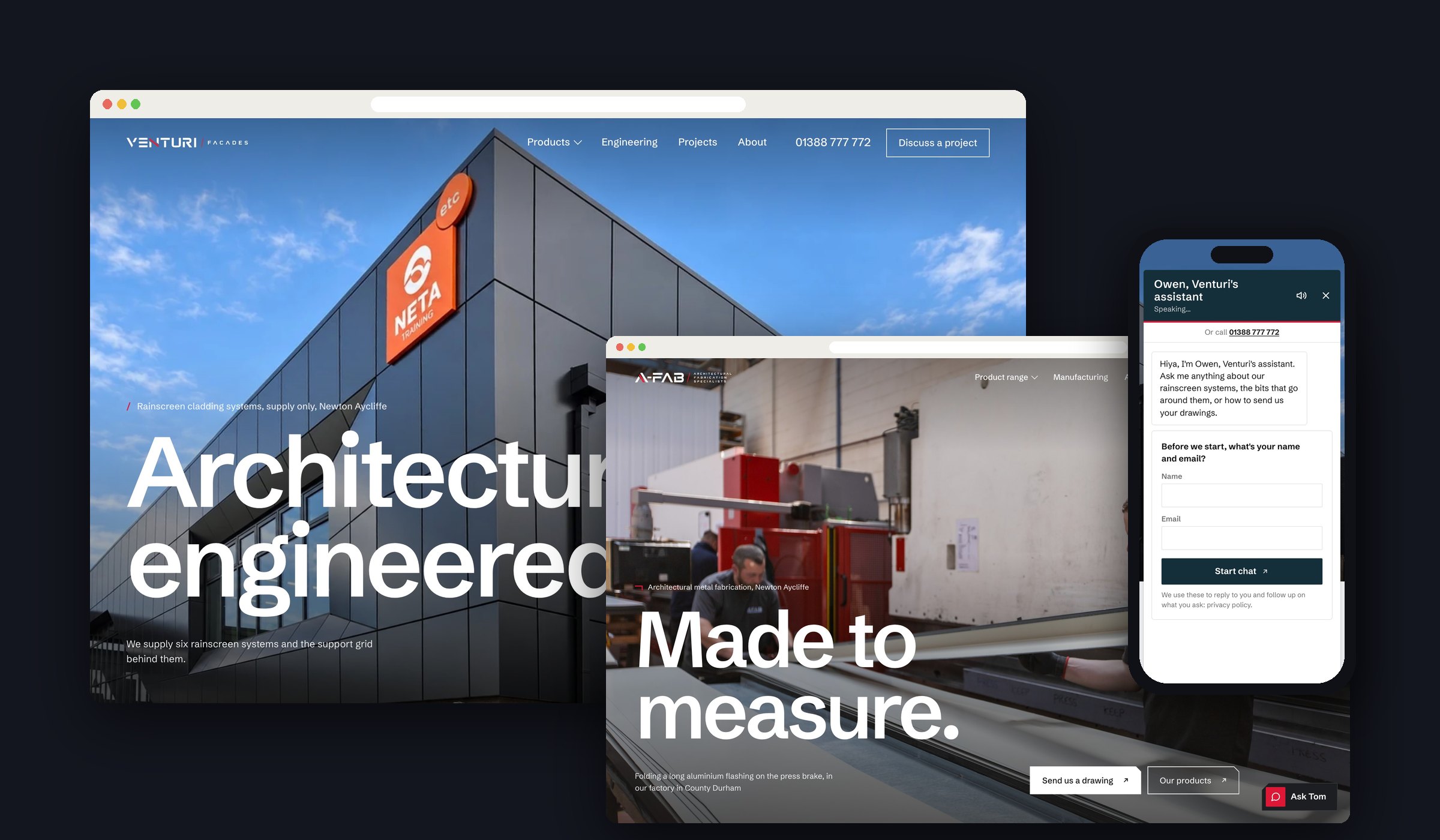
Two new websites for two sister companies in Newton Aycliffe. Venturi Facades supplies rainscreen façade systems and A‑FAB makes architectural metalwork to drawings. Every product page has its own film, and each site has an assistant that answers questions out loud.
- Client
- Venturi Facades and A‑FAB
- Sector
- Façades and metal fabrication
- What we did
- Websites, brand, films, photography, AI assistants, search
- When
- June 2025 to November 2026
What we made
Two sister companies, and one brief
Venturi Facades supplies rainscreen systems, cladding and the support grids behind them. It does not install. Its sister company A‑FAB cuts, punches, folds and welds flashings, gutters, pressings and steelwork to drawings. Venturi’s site carried a lot on every page, and A‑FAB needed a site from the ground up.
On a call on 9 November, Graham Todd, Venturi’s managing director, asked for these:
- A full refresh, with Venturi stripped back and cleaner
- A‑FAB very similar, with a clear difference so people know which site they are on
- New fonts, because neither of us liked the old ones
- A film on each page, so it is clear what goes where
- Chatbots on both sites, well tested, that pass people to the team when unsure
- Every enquiry to one inbox
From a factory shoot to two finished sites
- June 2025
The factory shoot
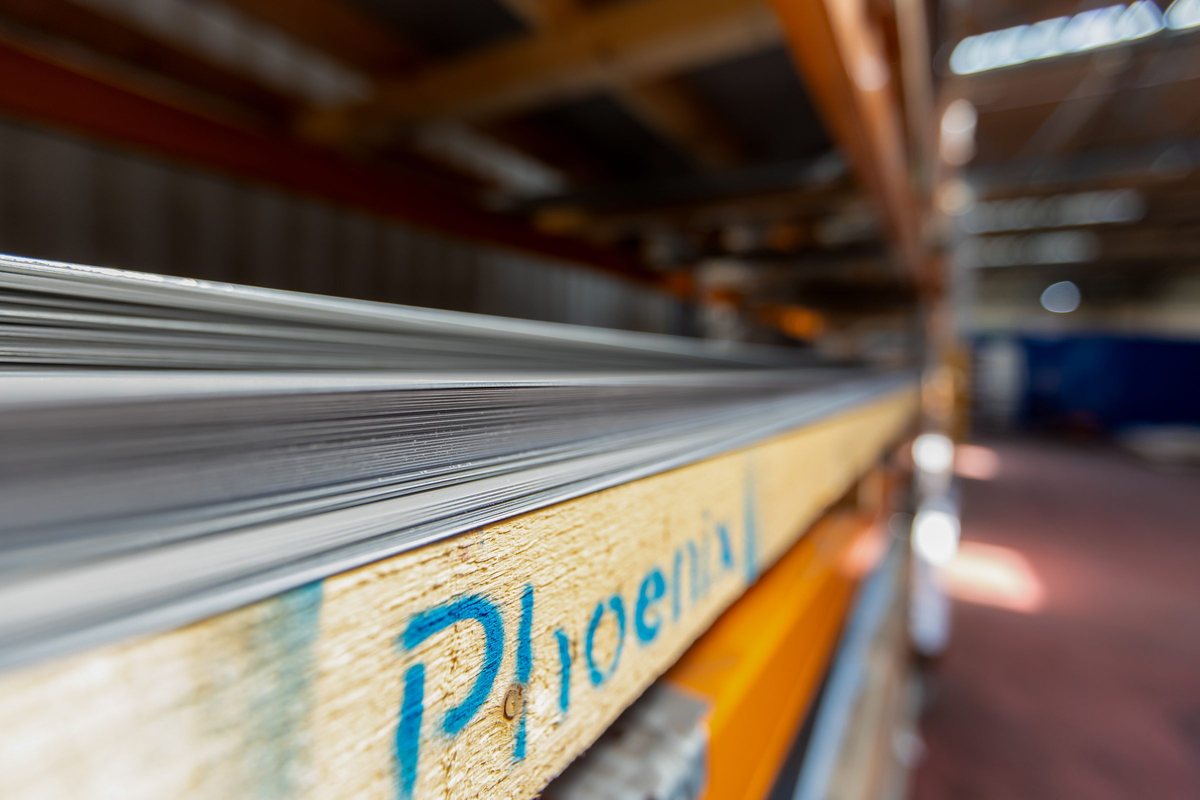
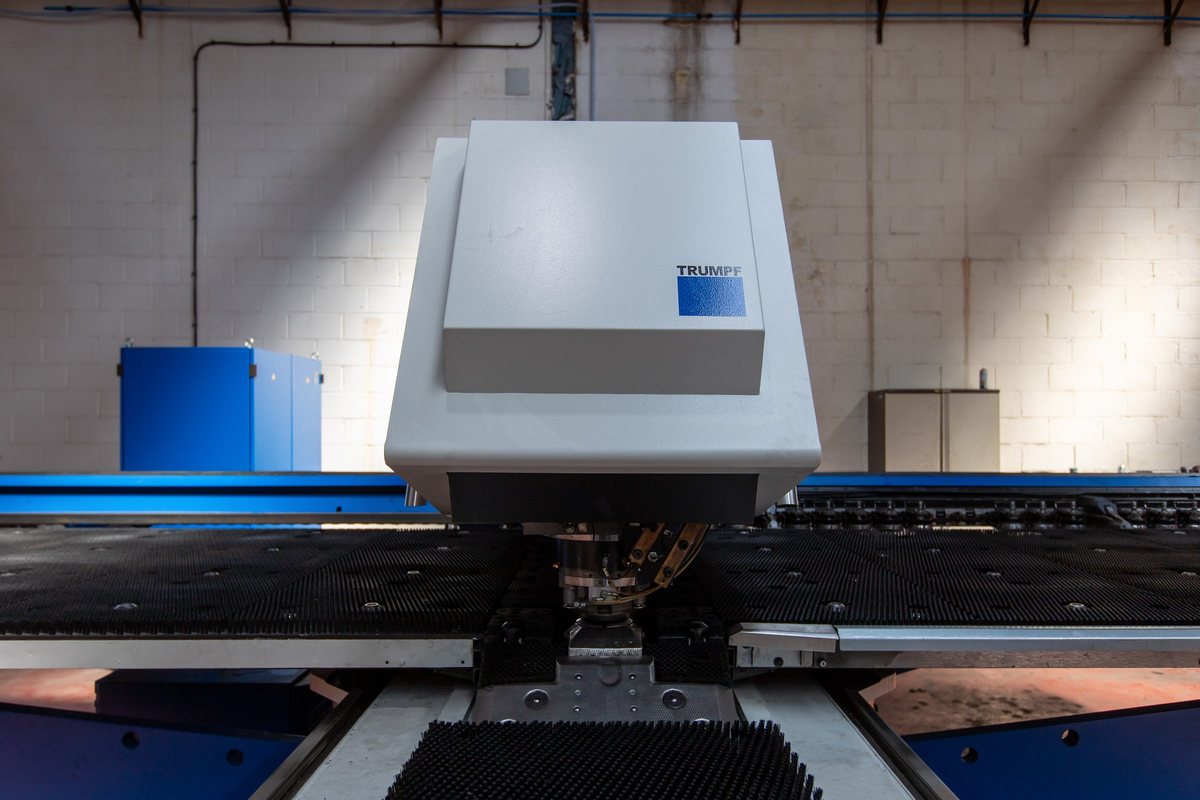
A day photographing the workshop: press brakes, punch presses, the welding bay and finished stock. 146 frames edited.
- August 2026
First call
A more professional site, a mega menu like ours, a proper projects page and searches beyond the company name.
- 9 November
A full refresh
The brief: cleaner pages, new fonts, a film per page and chatbots on both sites.
- 21 November
The new design
White pages, one font, navy kept for one or two bands, and every page built around what an architect or contractor needs to find.
- 23 November
Approved
Graham signed off the design on the call. Next, the move to the firms’ own domains.
The first screen, then and now
What a visitor saw first on each firm’s old site, and what they see now.
Venturi Facades
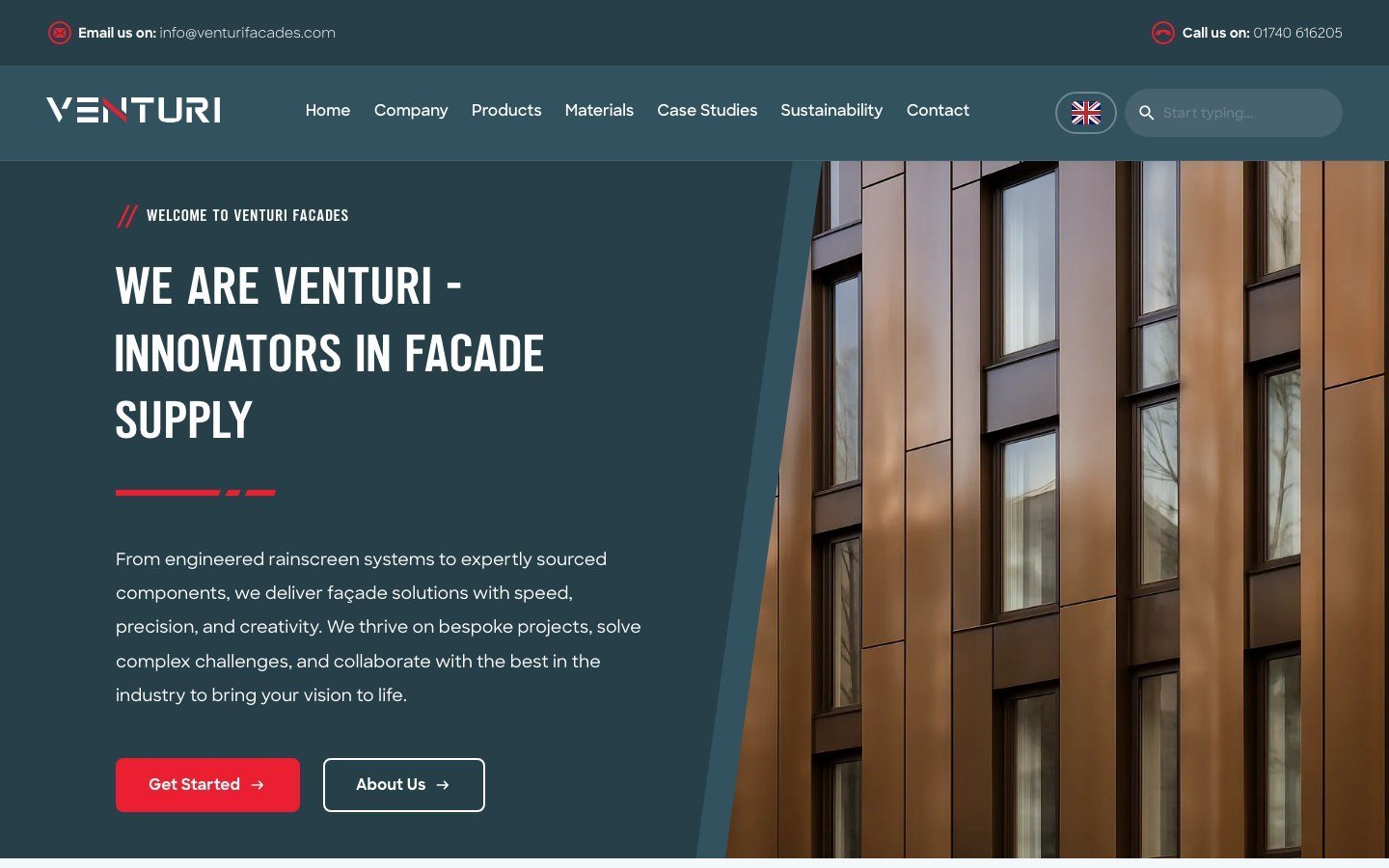
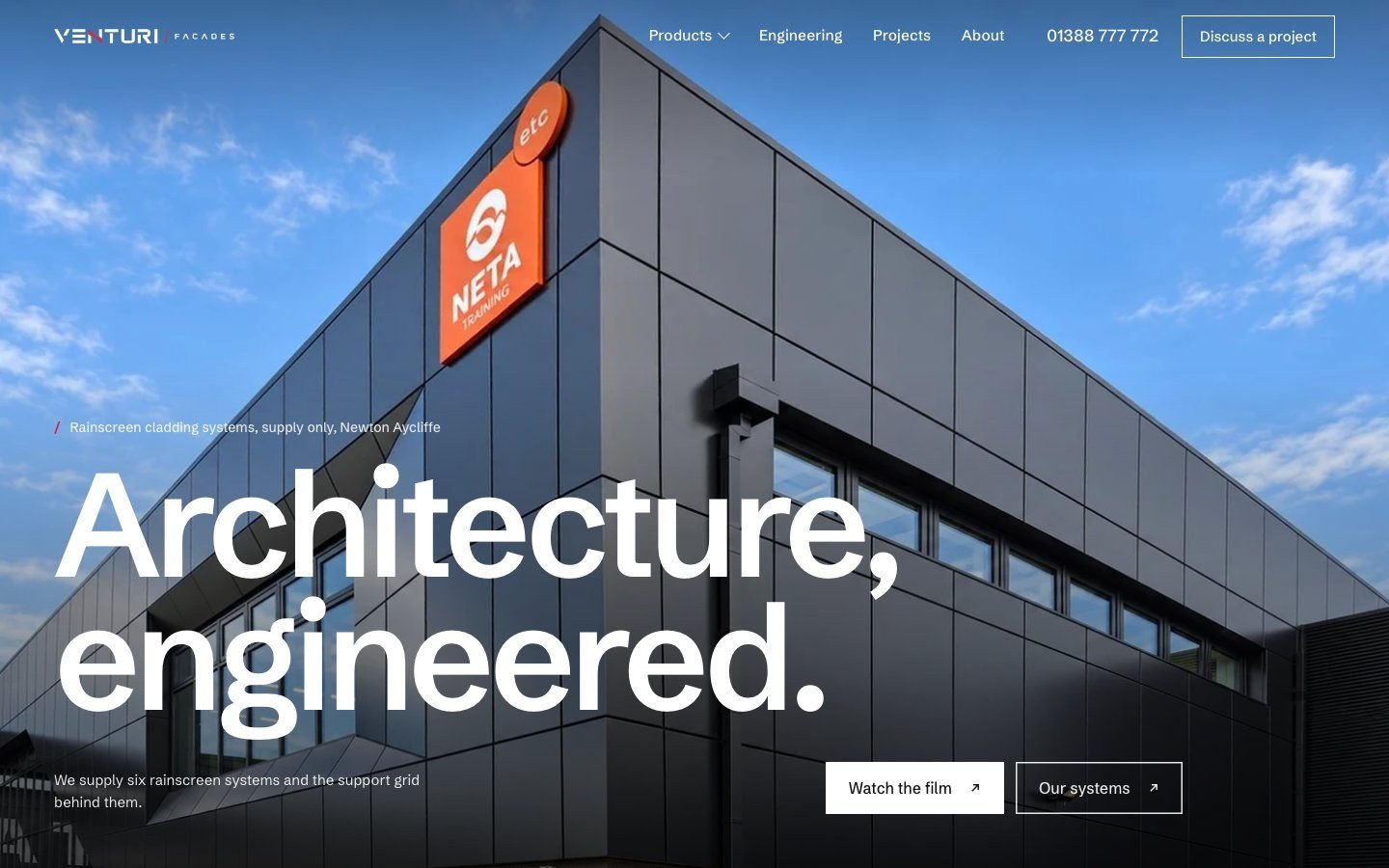
Graham asked for Venturi stripped back. The old page opened on a navy panel with a paragraph of text. The new one opens on a real Venturi project with one line on what they supply. The old heading font also had no proper Ç, so façade never looked right. Every font in the new design has one.
A‑FAB
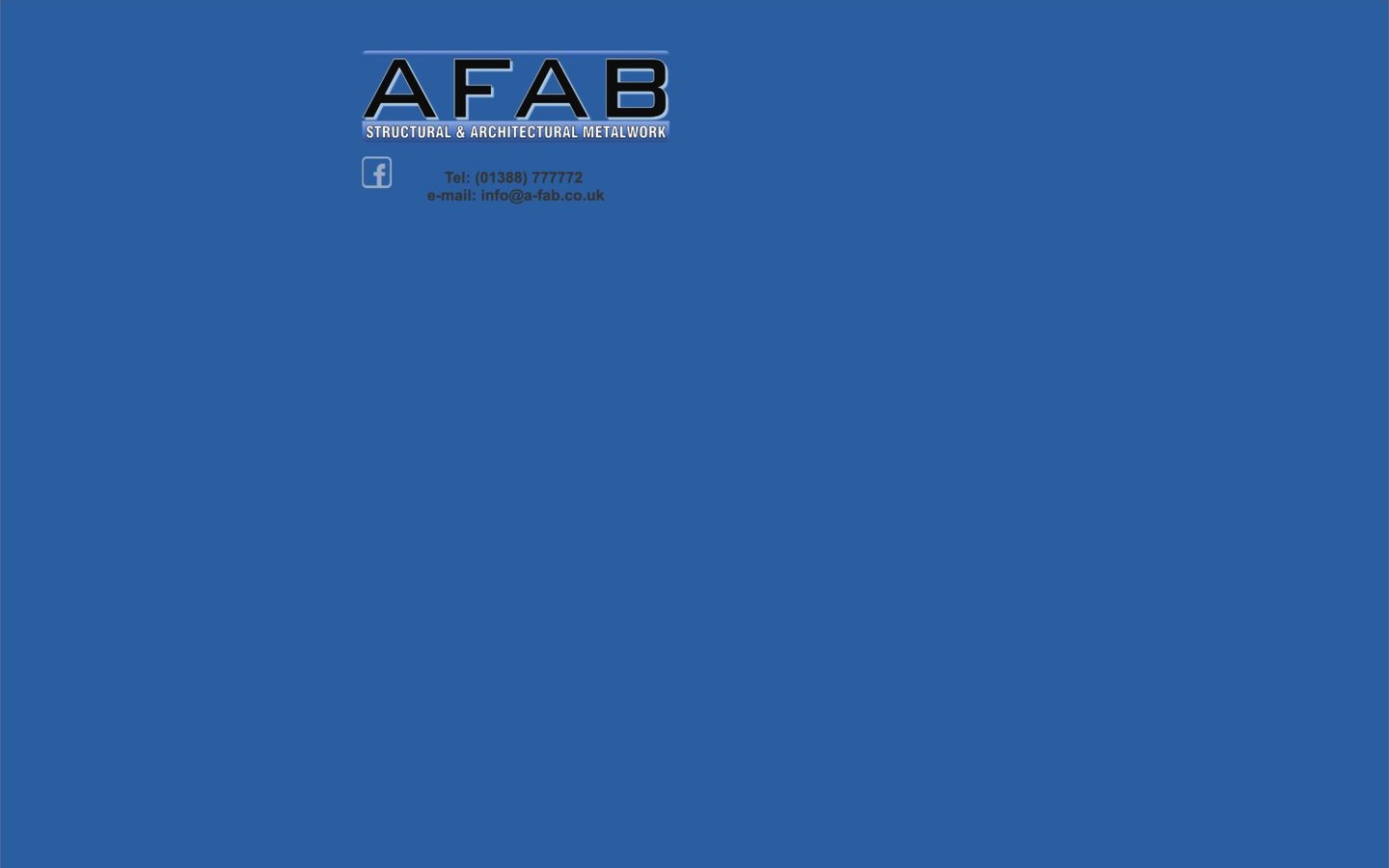
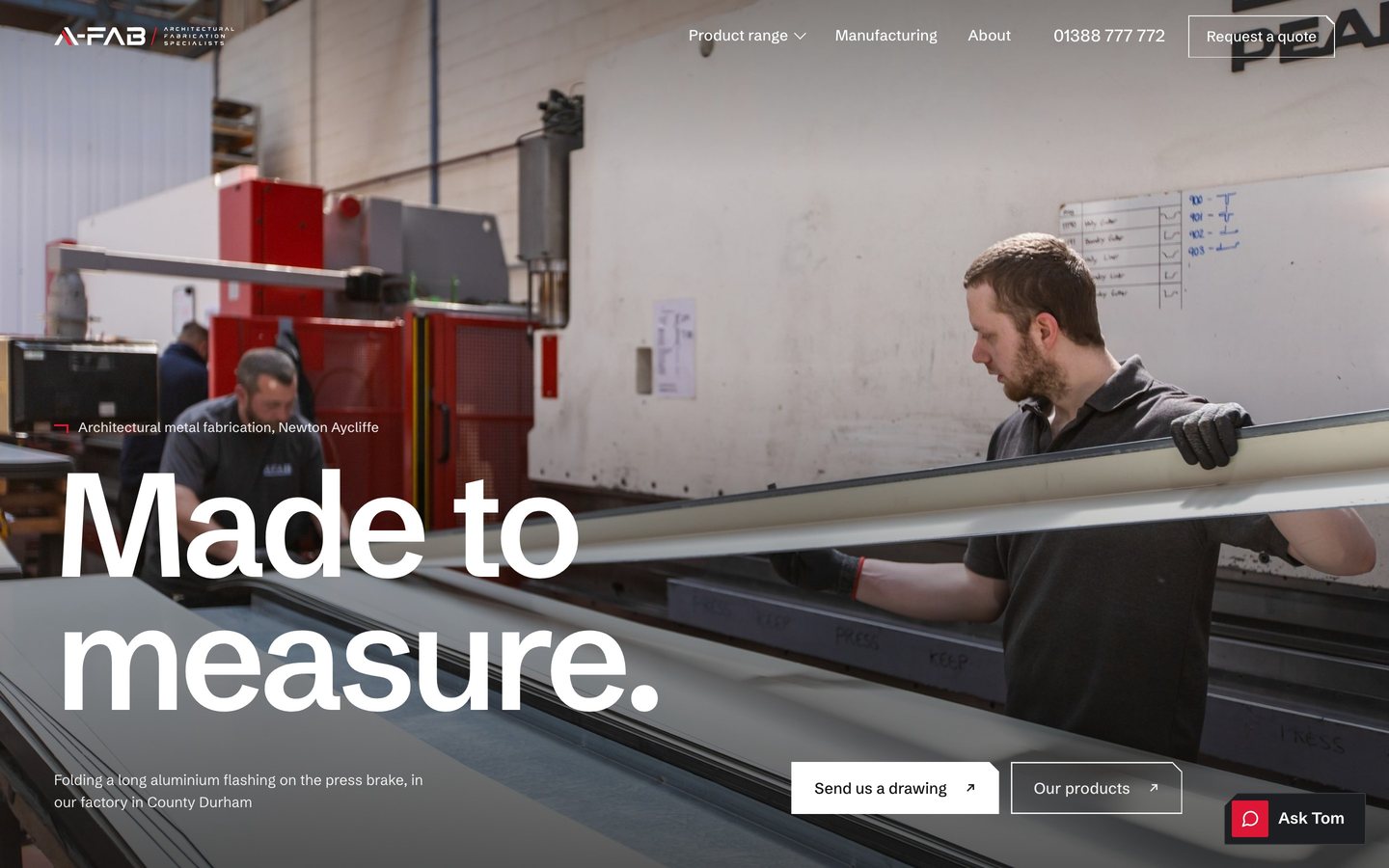
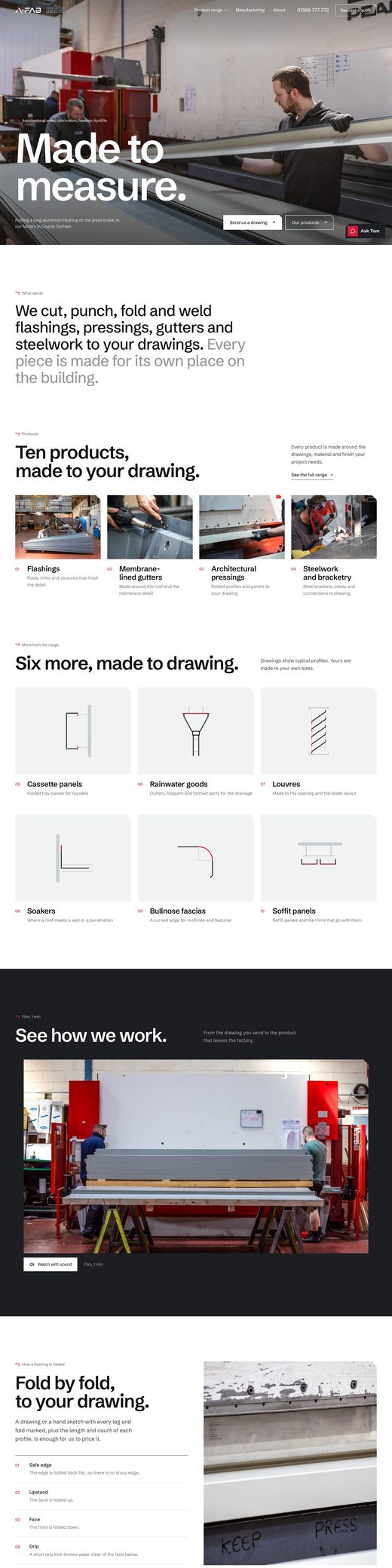
The old A‑FAB site opened on a blue panel with the logo, a phone number and an email address. The new one opens on the workshop at work, says what they make and gives two ways forward.
The home pages, before and after
Shrunk down like this, the difference is easy to see.
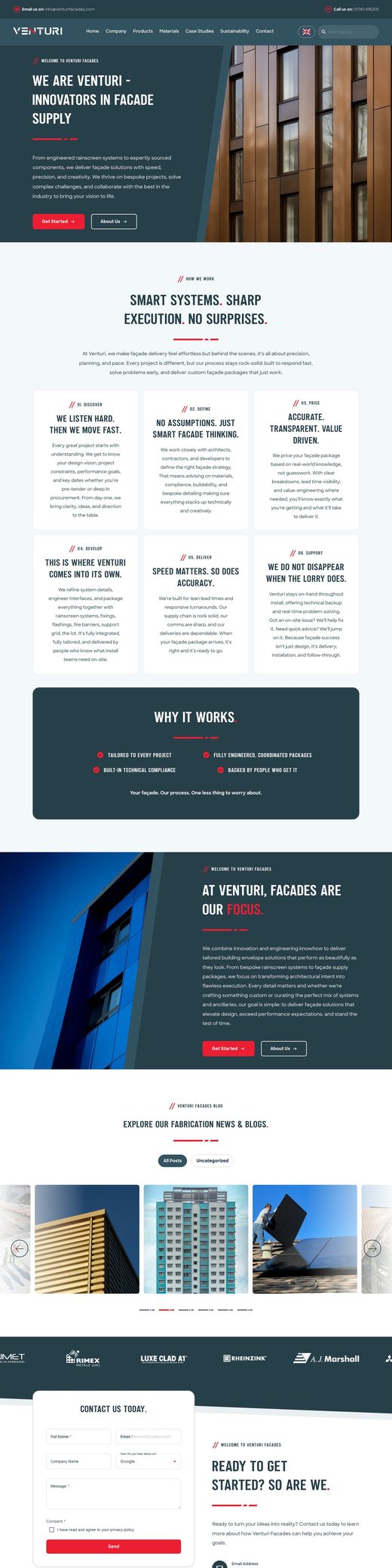
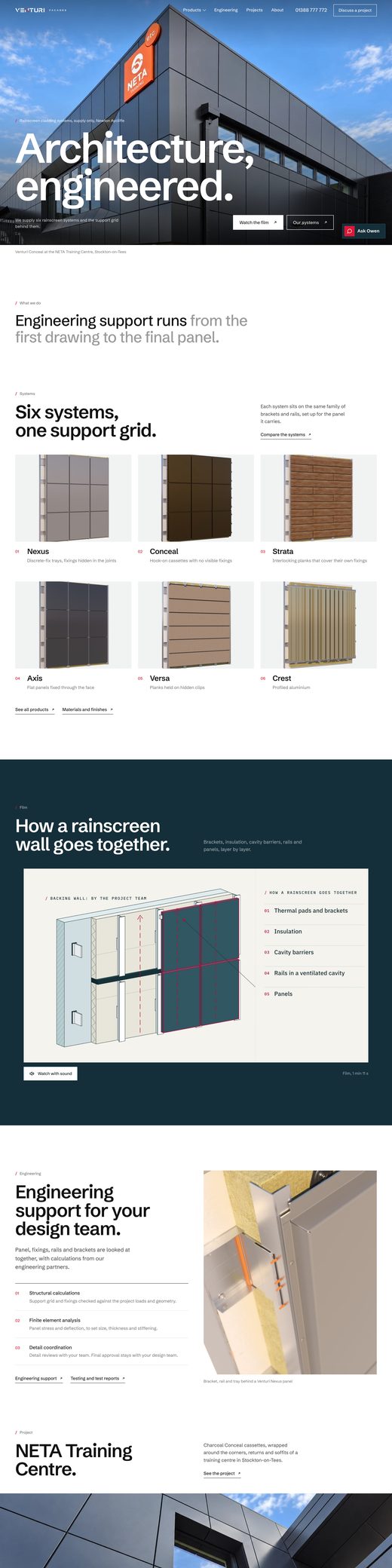
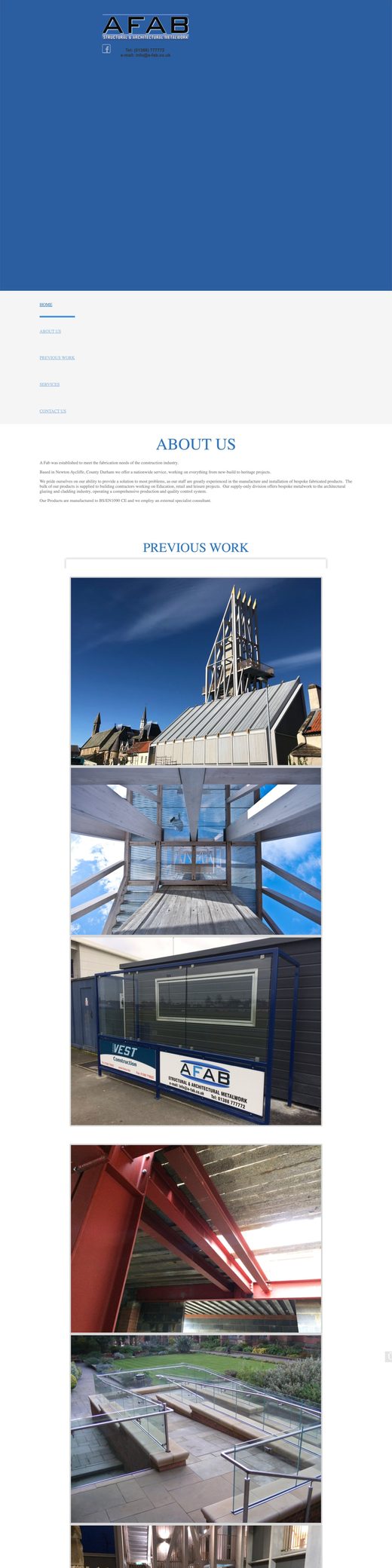
The old Venturi page ran navy panels and boxes of text all the way down. The new one is mostly white and photos, with one navy band in the middle. The old A‑FAB page was a blue header and a list of links before any work appeared. The new one starts with the workshop and the products.
Sister companies you can tell apart
Both sites share one font, the same layout and white pages, so they read as one family. Three small details keep them apart.

- White#FFFFFF
- Ink#121212
- Venturi navy#152F3A
- Logo red#DF1736
The red slash from the logo sits before every small label and numbers each list. Navy is saved for one or two bands on a page and the footer. Red is only ever used small, never as a filled block.

- White#FFFFFF
- Ink#121212
- A‑FAB graphite#1C1E21
- Red#DF1736
Graphite instead of navy. A small folded mark, like a bent flashing, before each label. Buttons and pictures get a pressed corner, like folded metal.
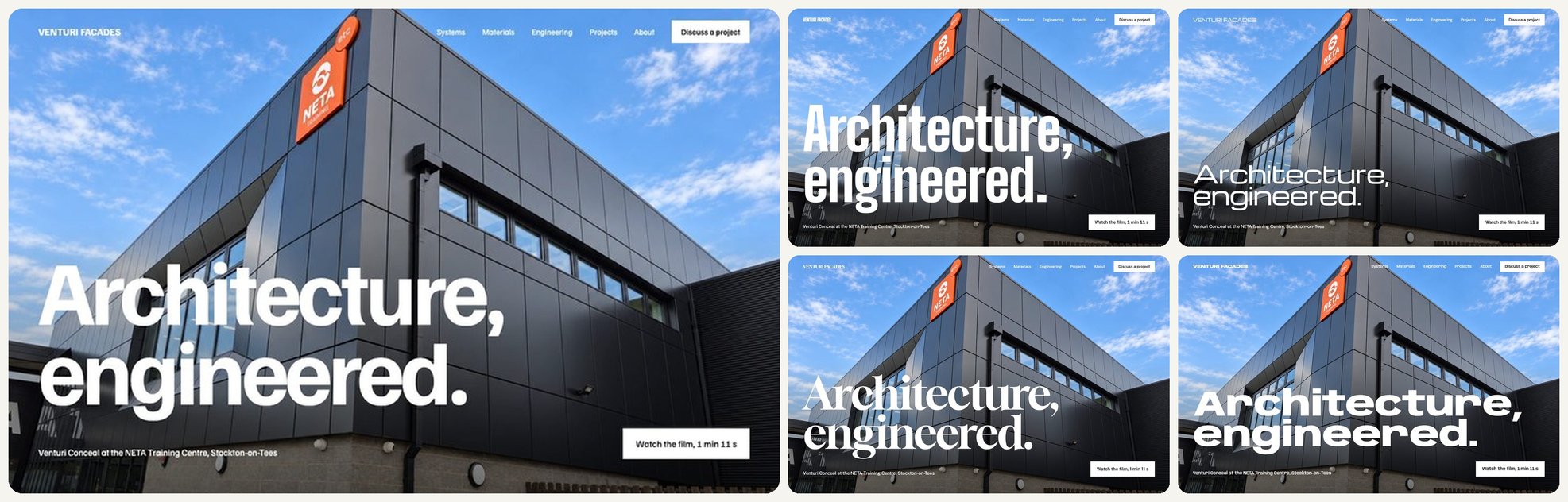
One font, chosen by testing
Schibsted Grotesk, picked after setting the same home page in 6 other fonts.
It reads clearly from the big headlines down to product details, it has a real Ç for façade, and using one font on both sites helps them feel related. It is free to use on the web and in print, so the firms can use it in their own documents too.
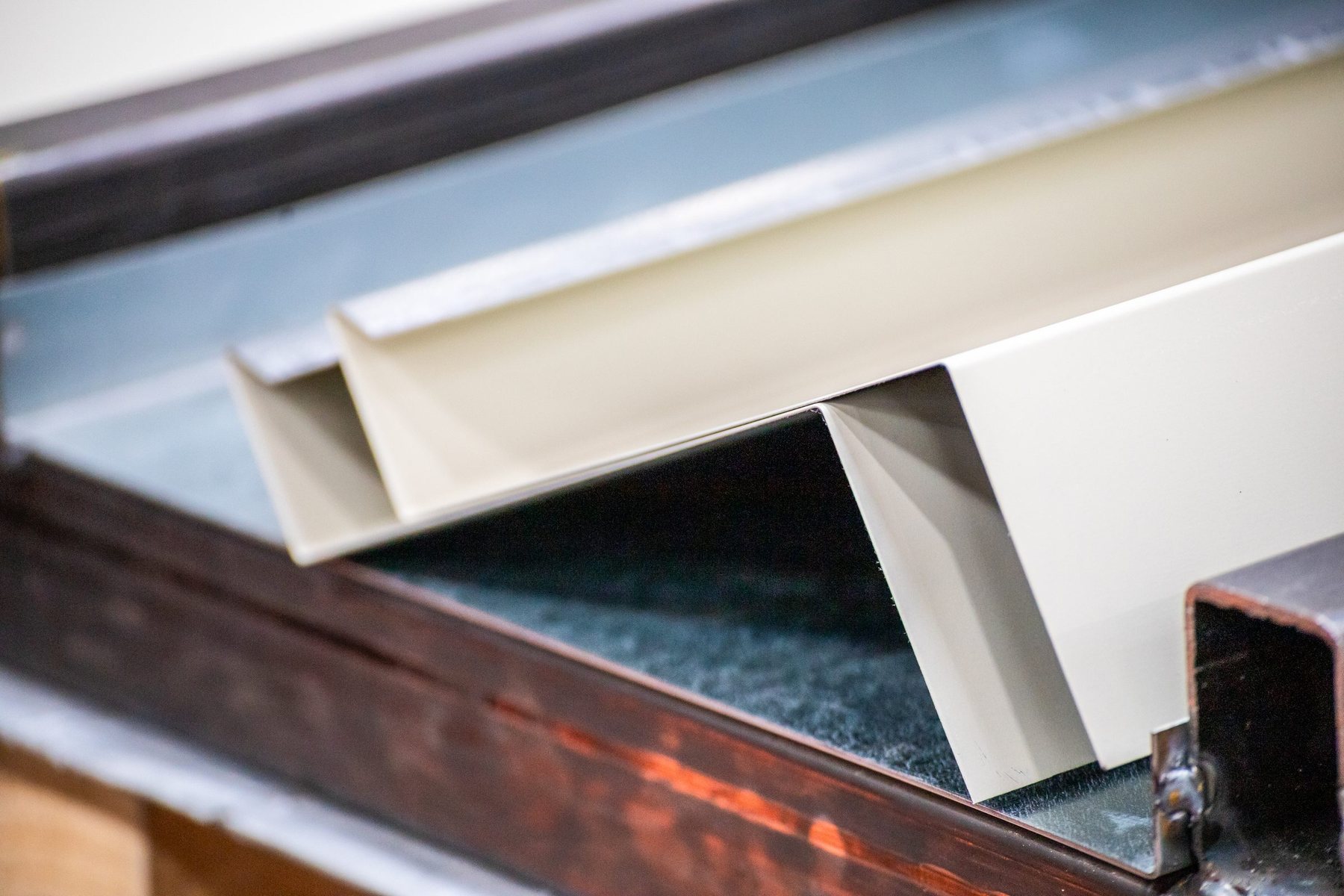
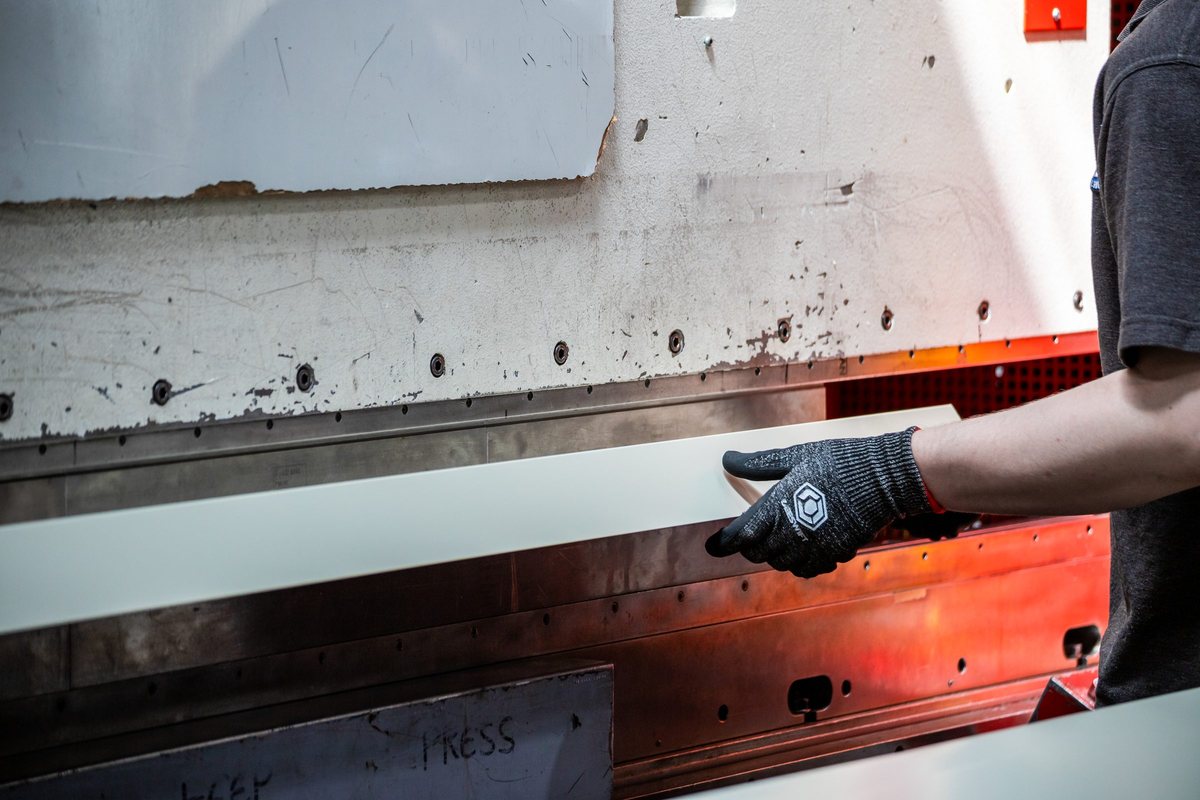
A day in the workshop
Theo photographed the workshop in June 2025 and edited 146 frames. They run through both sites and the films. No stock photos and nothing made by AI.
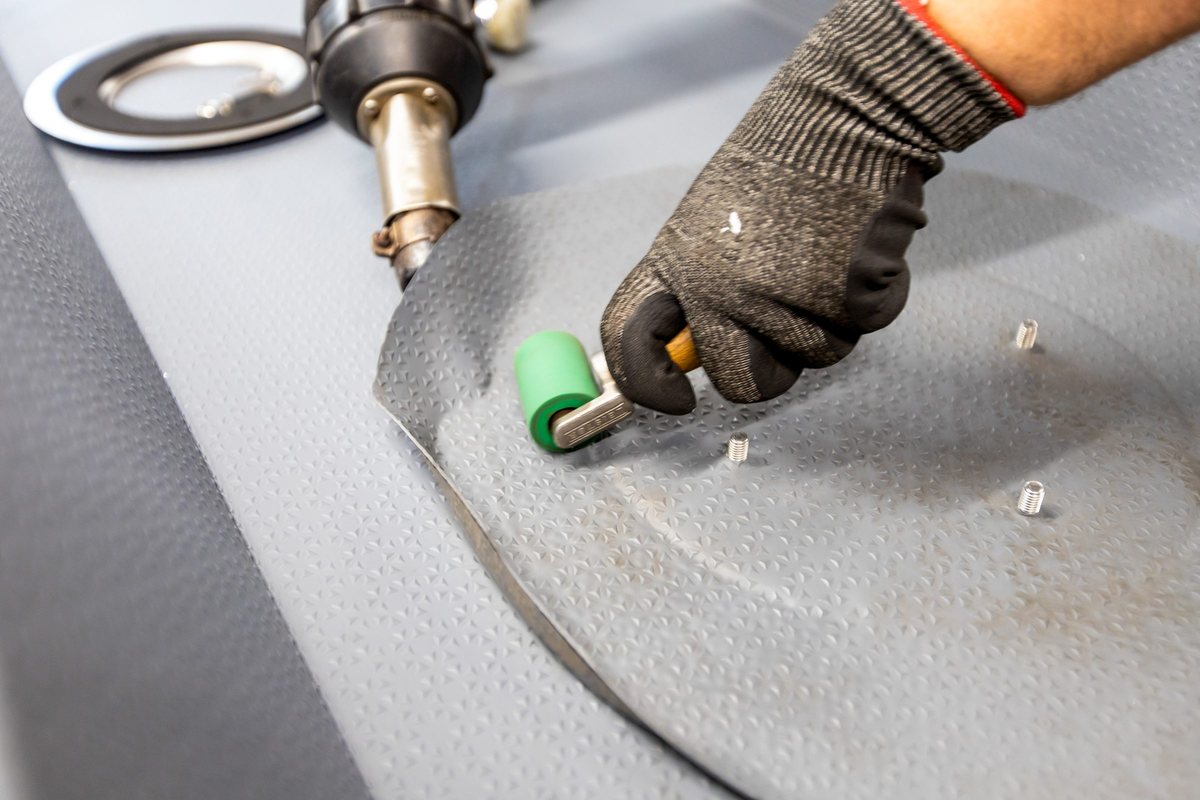
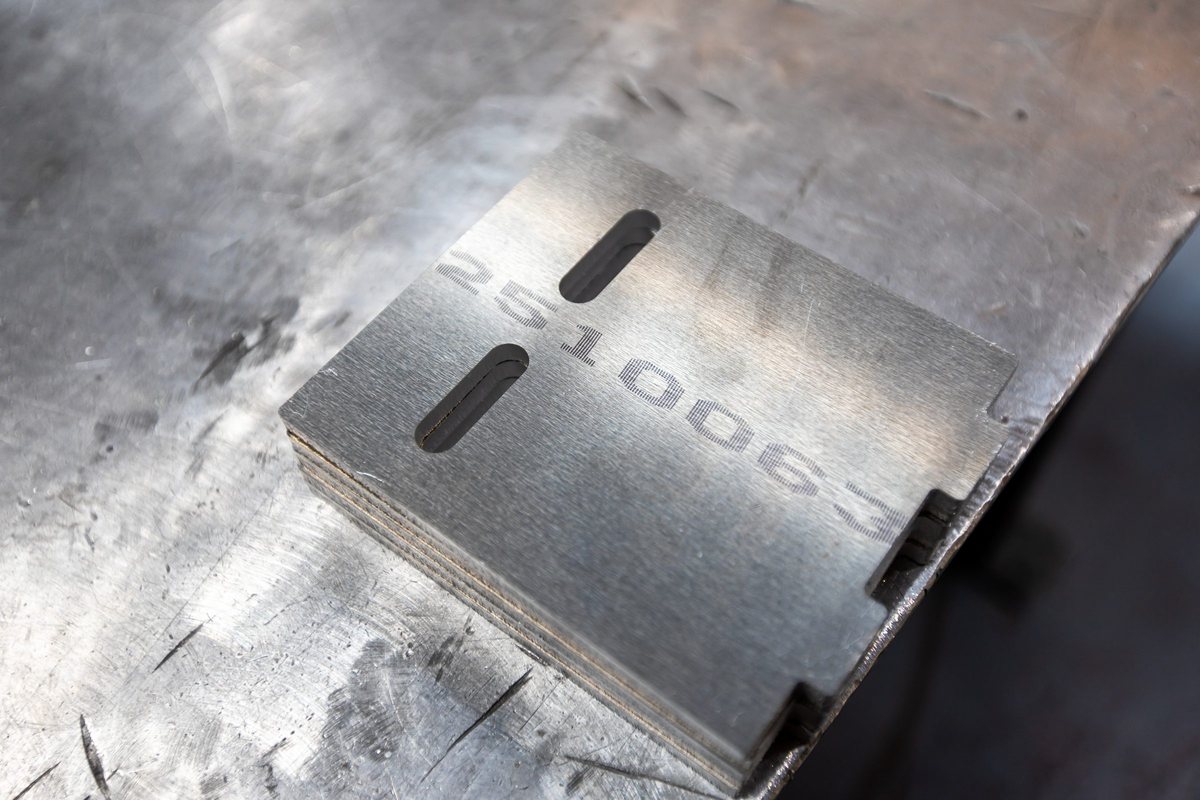
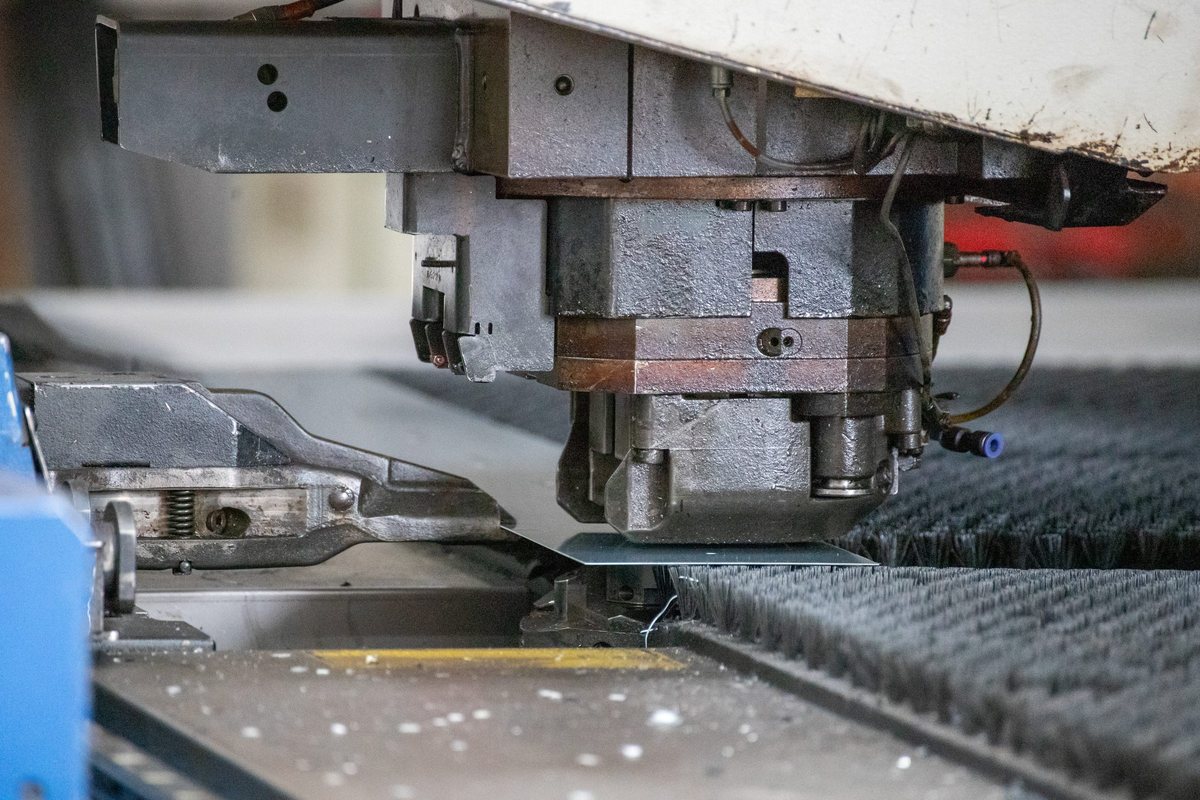
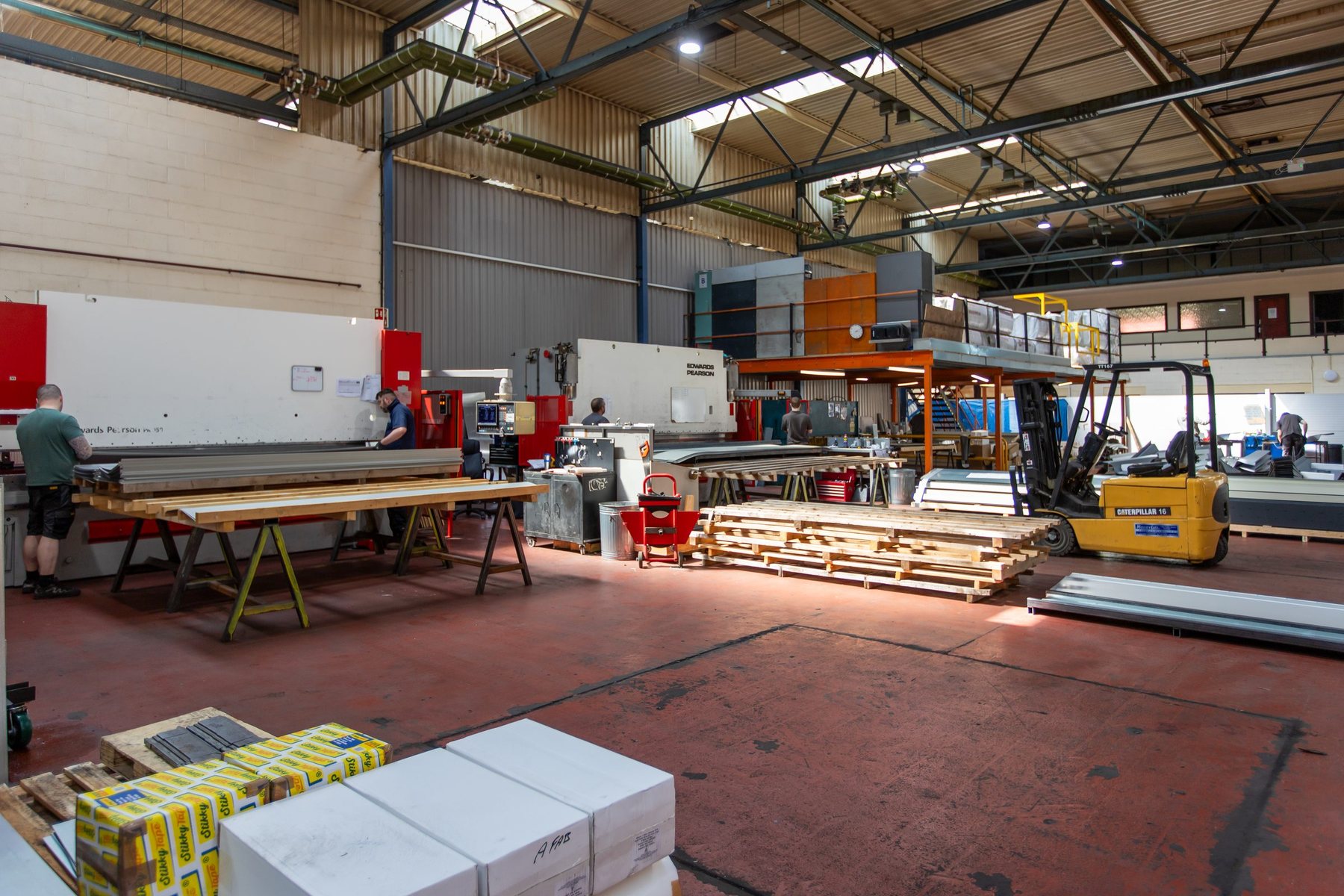
Their photos, straightened
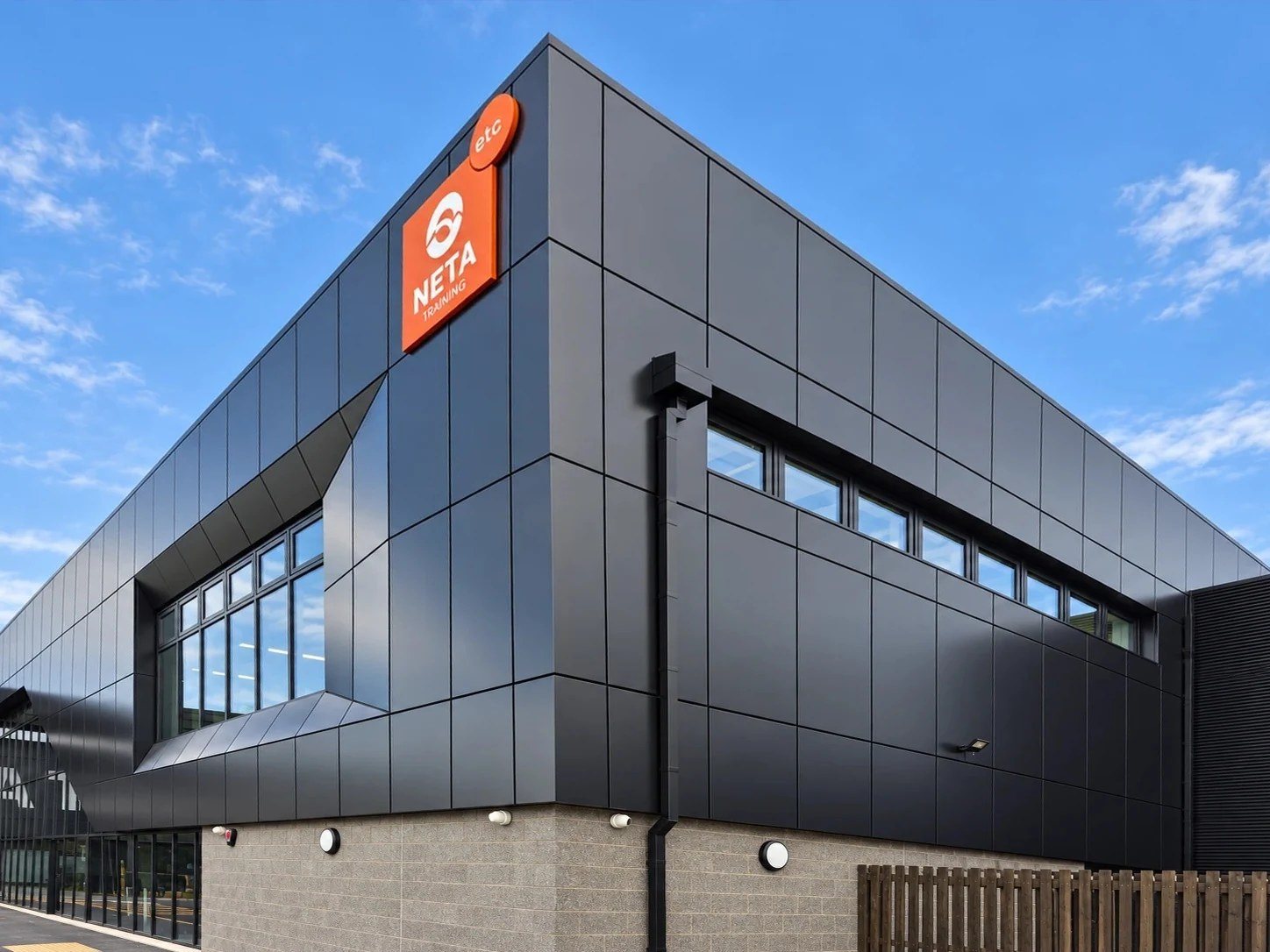
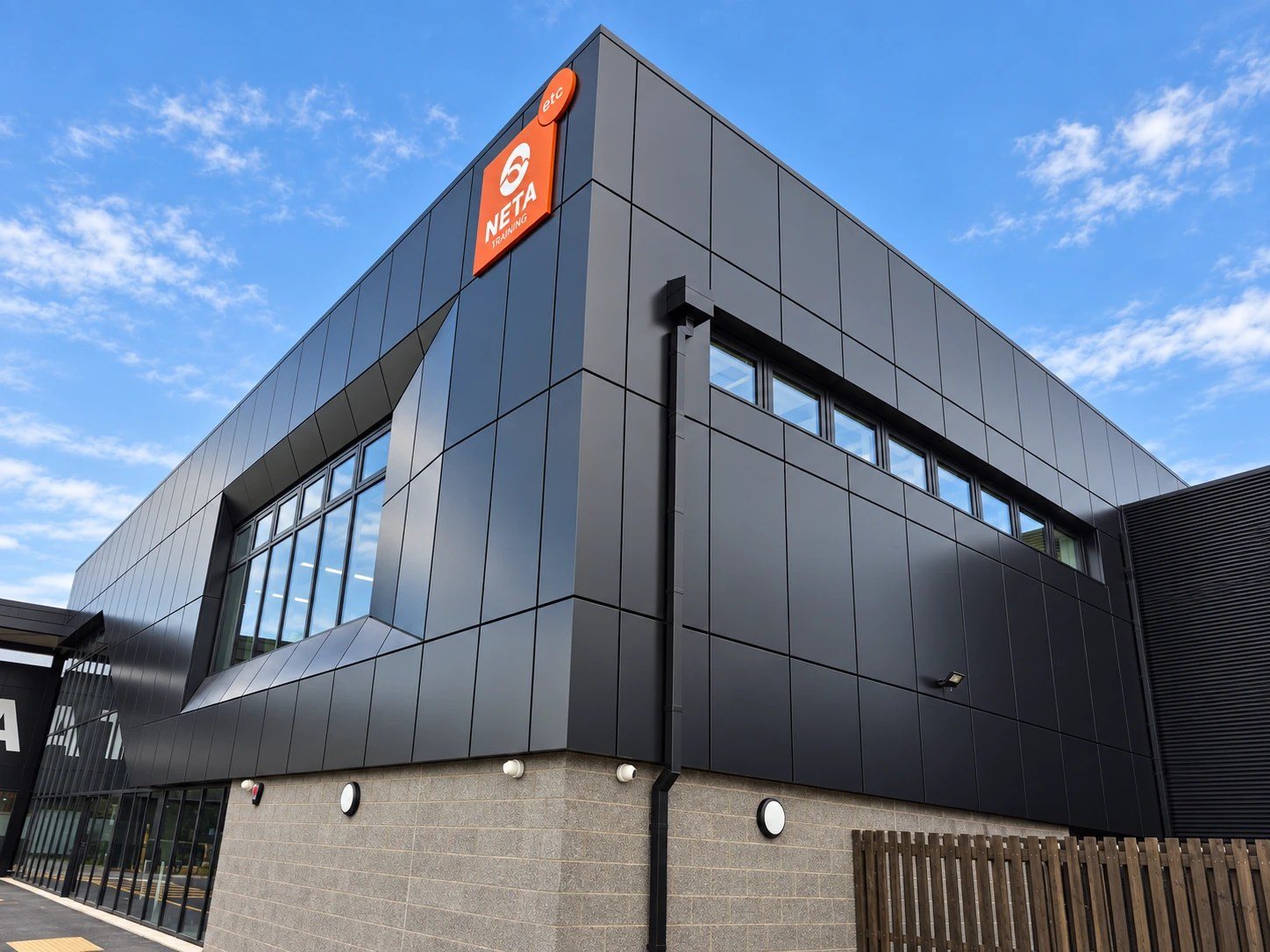
Not every photo on the sites is ours. This one of NETA Training Centre is Venturi’s own, taken looking up, so the walls leaned in by up to 13 degrees at the edges.
We edited their existing photo so the uprights stand straight, the way they would on an architectural shoot, and used the edited version on every page and in the Venturi film. Drag the slider to compare. Project photos they send in get the same edit.
Planned around what specifiers look for
One page for every system, board, material and product, each with an address that matches the search a specifier would type. 68 pages in all.
- Rainscreen systems 6NexusConcealStrataAxisVersaCrest
- Cladding boards 6EquitoneSwisspearlFundermaxRockpanelJames HardieSteni
- Specialist cladding and partsXPANBriklokDecorative claddingSpandrel panelsBespoke panelsSupport gridsCavity barriersFabrications
- Materials 7Anodised aluminiumPowder coated aluminiumPre-painted aluminiumZincCopperWeathering steelStainless steel
- Engineering, testing and resources
- ProjectsNETA Training Centre
- Blog, about and contact
- Products 10FlashingsArchitectural pressingsLined guttersRainwater goodsLouvresSoakersBullnose fasciasSoffit panelsCassette panelsSteelwork and bracketry
- ManufacturingDrawing reviewCut and formFabricatePack and deliver
- About, blog and contact
A product page, taken apart
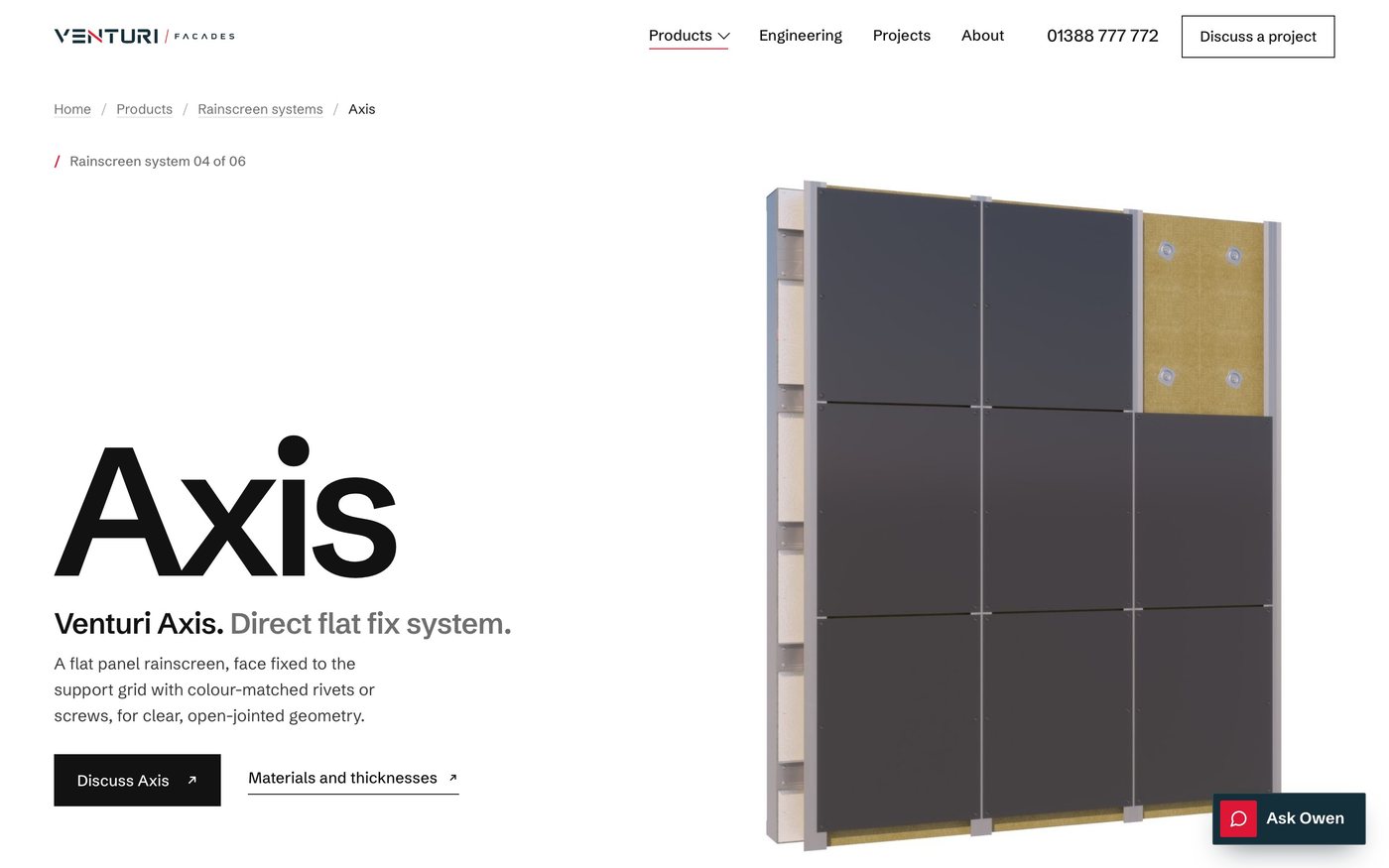
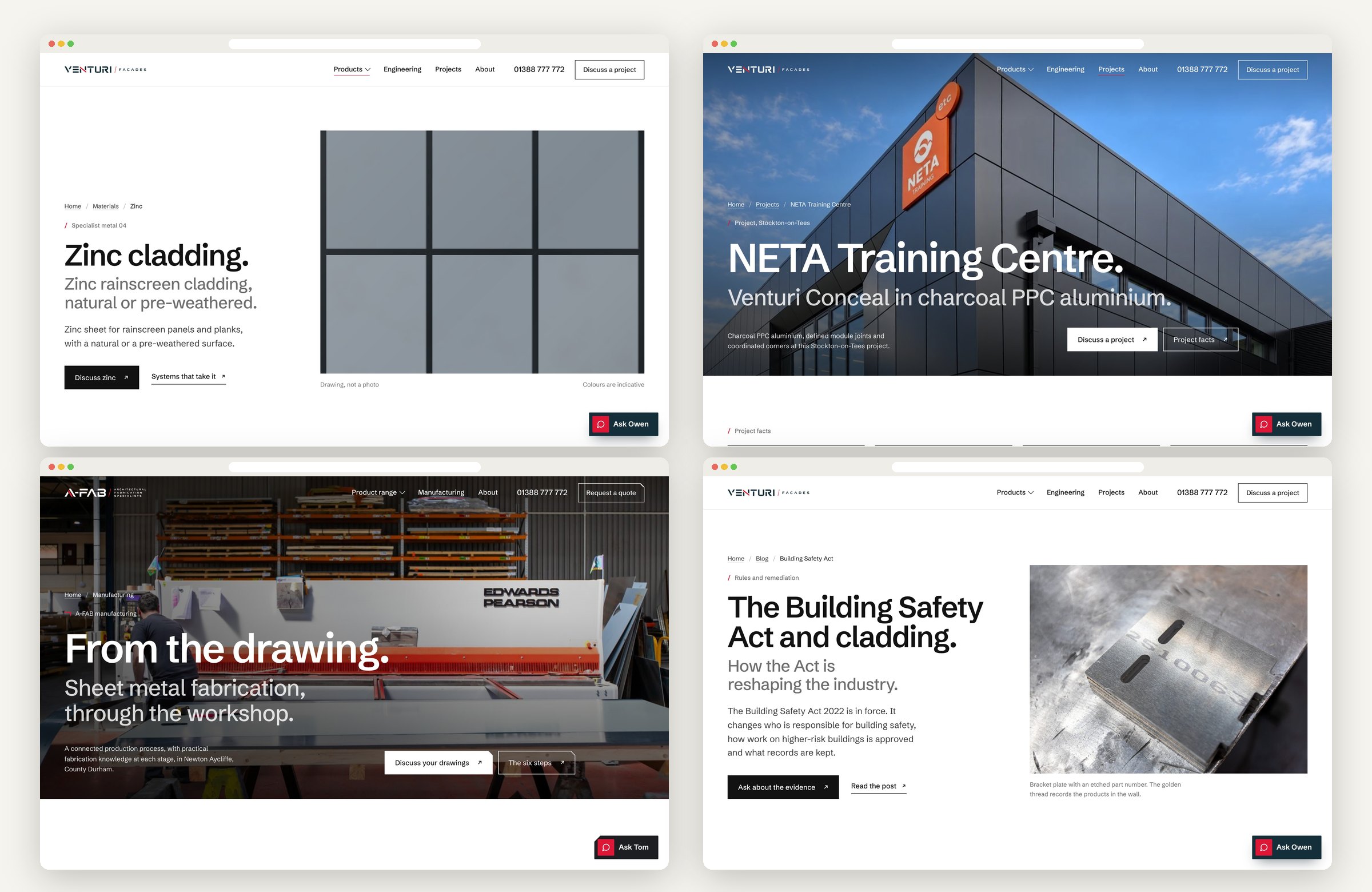
Every system page follows the same order, so a specifier finds the same thing in the same place each time. This is Venturi Axis, from top to bottom.
 01
The system first
The page opens on the system itself, large on white, with one line on what it is and two buttons.
A specifier sees what Axis is before reading a word.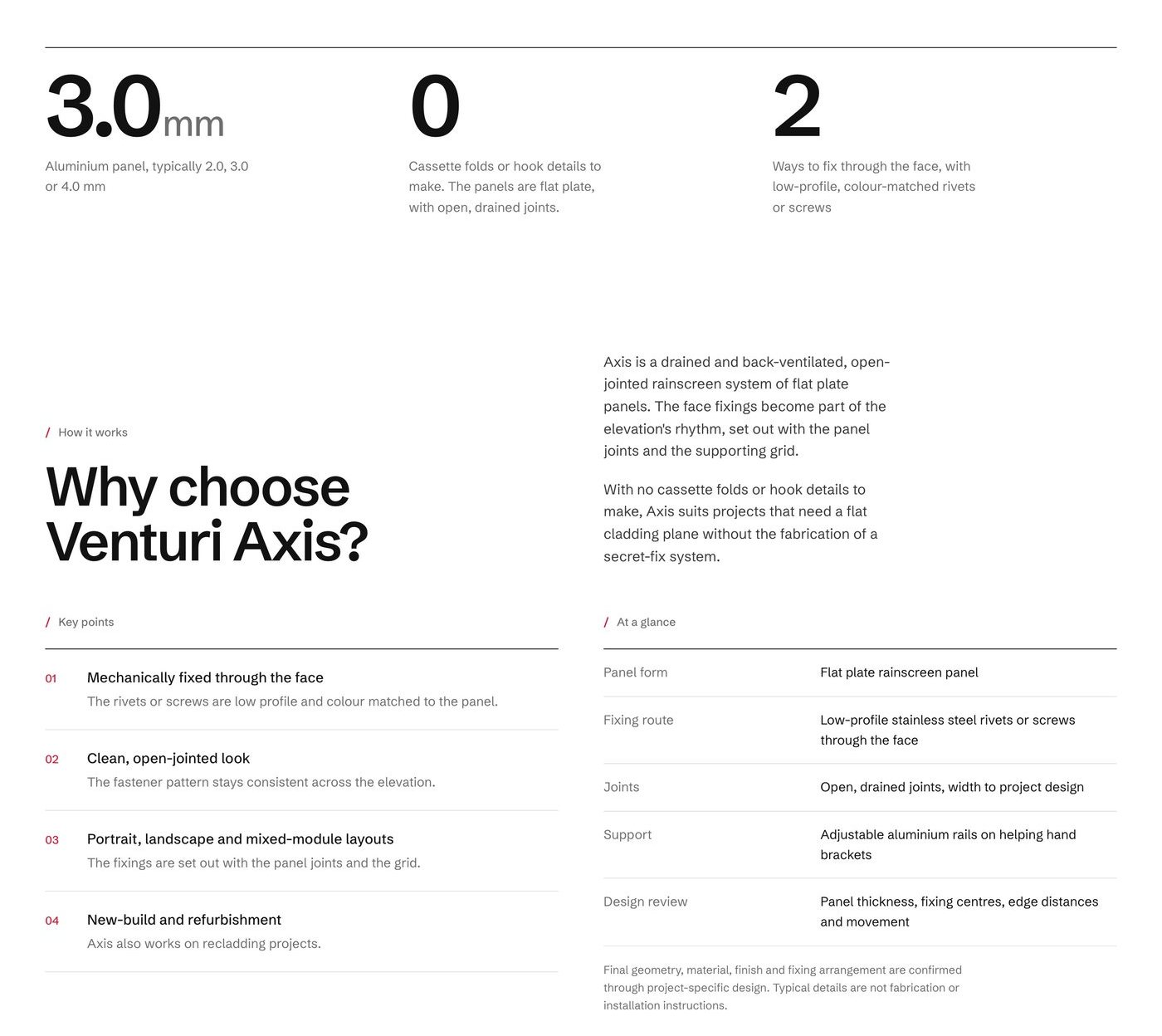 02
Key figures, then the reasons
Panel thickness, the folds to make and the ways to fix it, in big numbers. Then why you would choose it, with its parts in a short table.
The three numbers an engineer asks first are the first thing under the fold.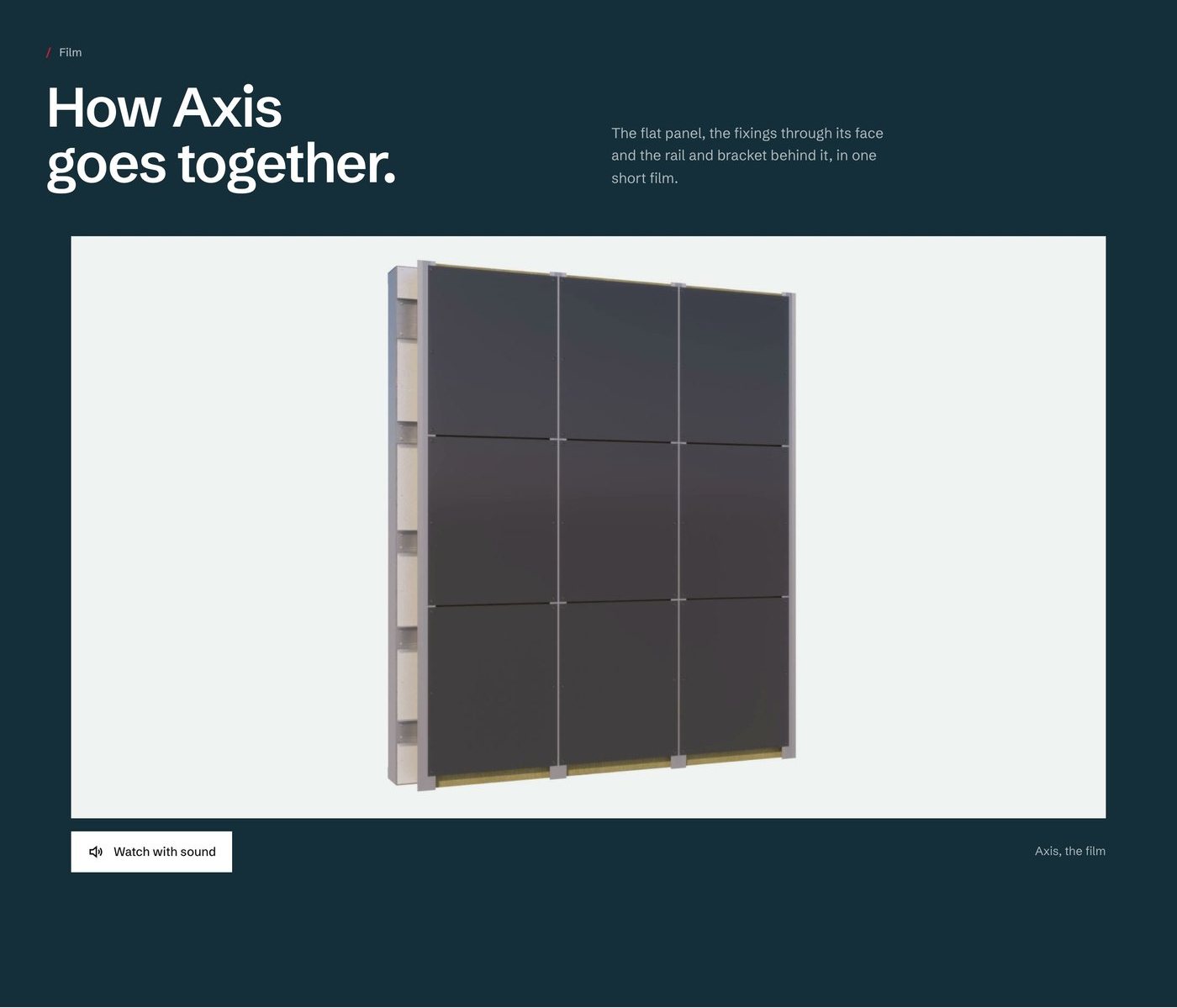 03
The film
A 35-second film of how Axis goes together, on the one navy band of the page.
Graham asked for a film on each page, so it is clear what goes where.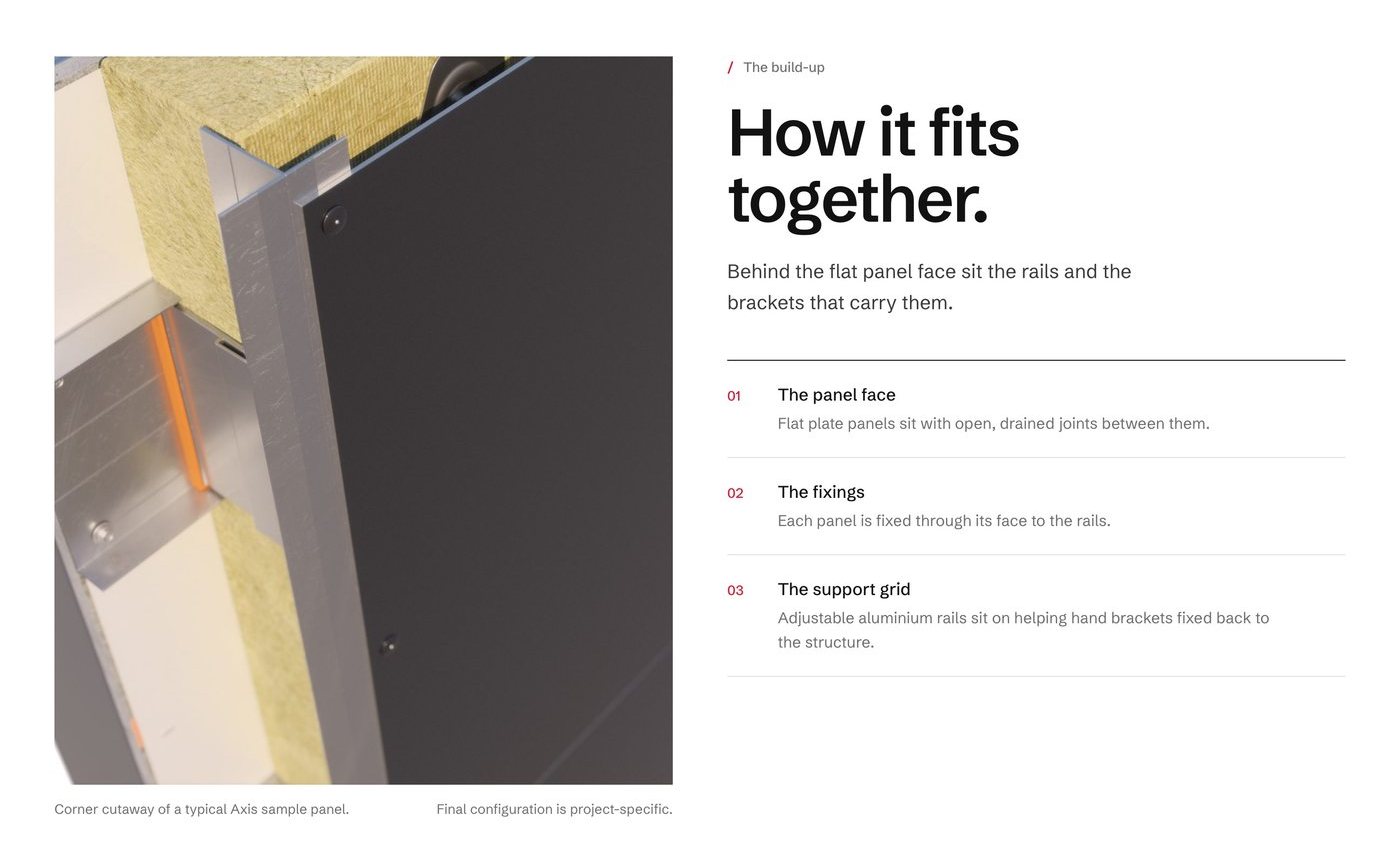 04
How it fits together
A cutaway of the build-up, with the panel, the fixings and the support grid named in order.
The parts are named in the order they go on the wall.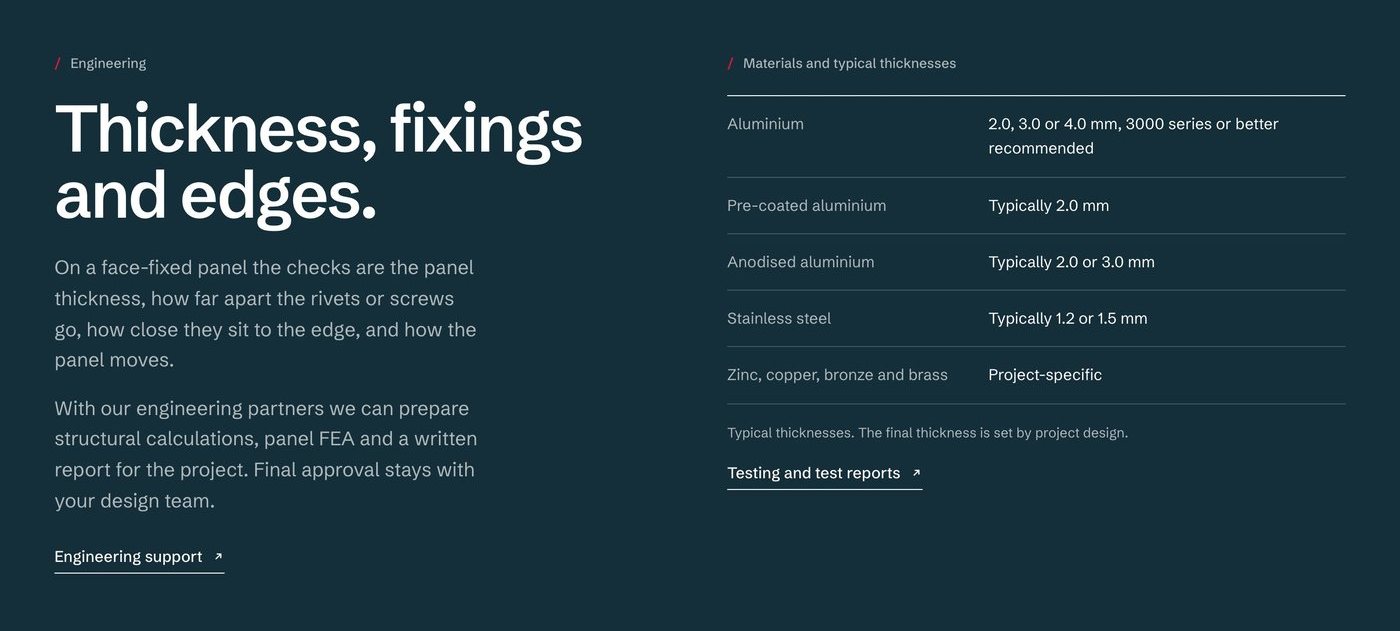 05
Thickness, fixings and edges
The detail a façade engineer checks, laid out as a table, with a link to engineering support.
Kept to facts the firm can back up. No test or certificate claims on the site.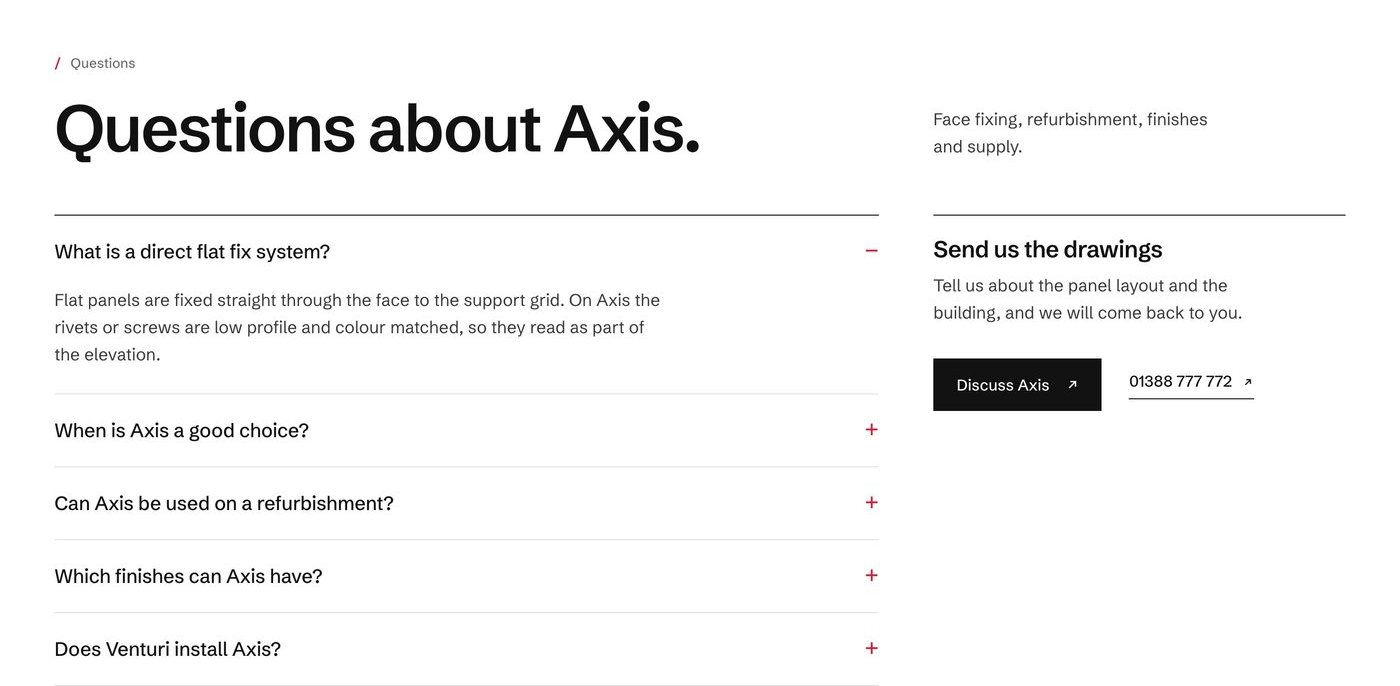 06
Questions
Plain answers to the questions people ask about Axis, such as when it is a good choice and whether it suits a refurbishment.
Clear answers like these are what Google and AI search quote.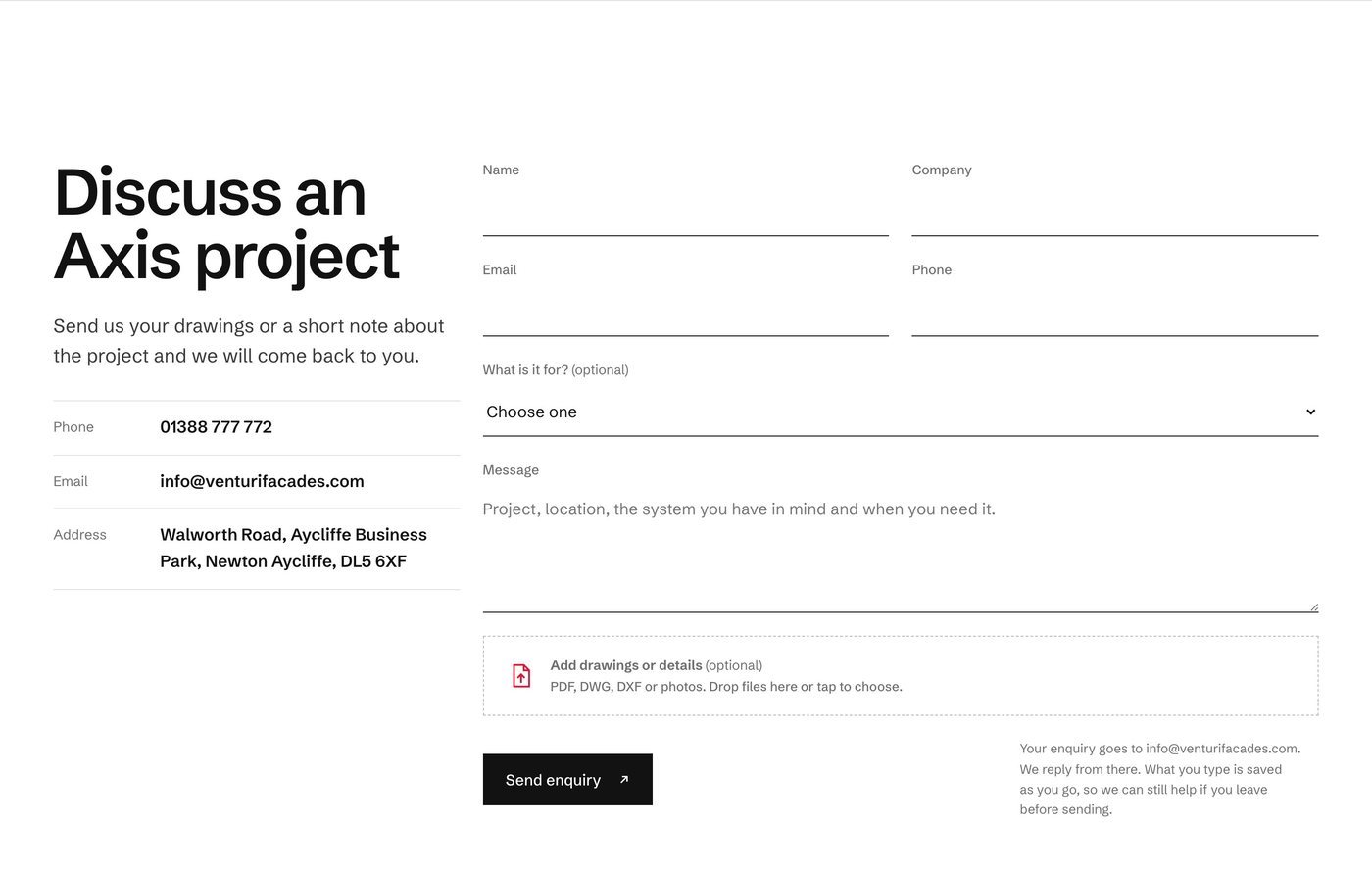 07
Discuss an Axis project
The enquiry form at the foot of the page, with drawings attached if the visitor has them. It records which page it was sent from.
The team knows which system the enquiry is about before they reply.
The same order on both sites
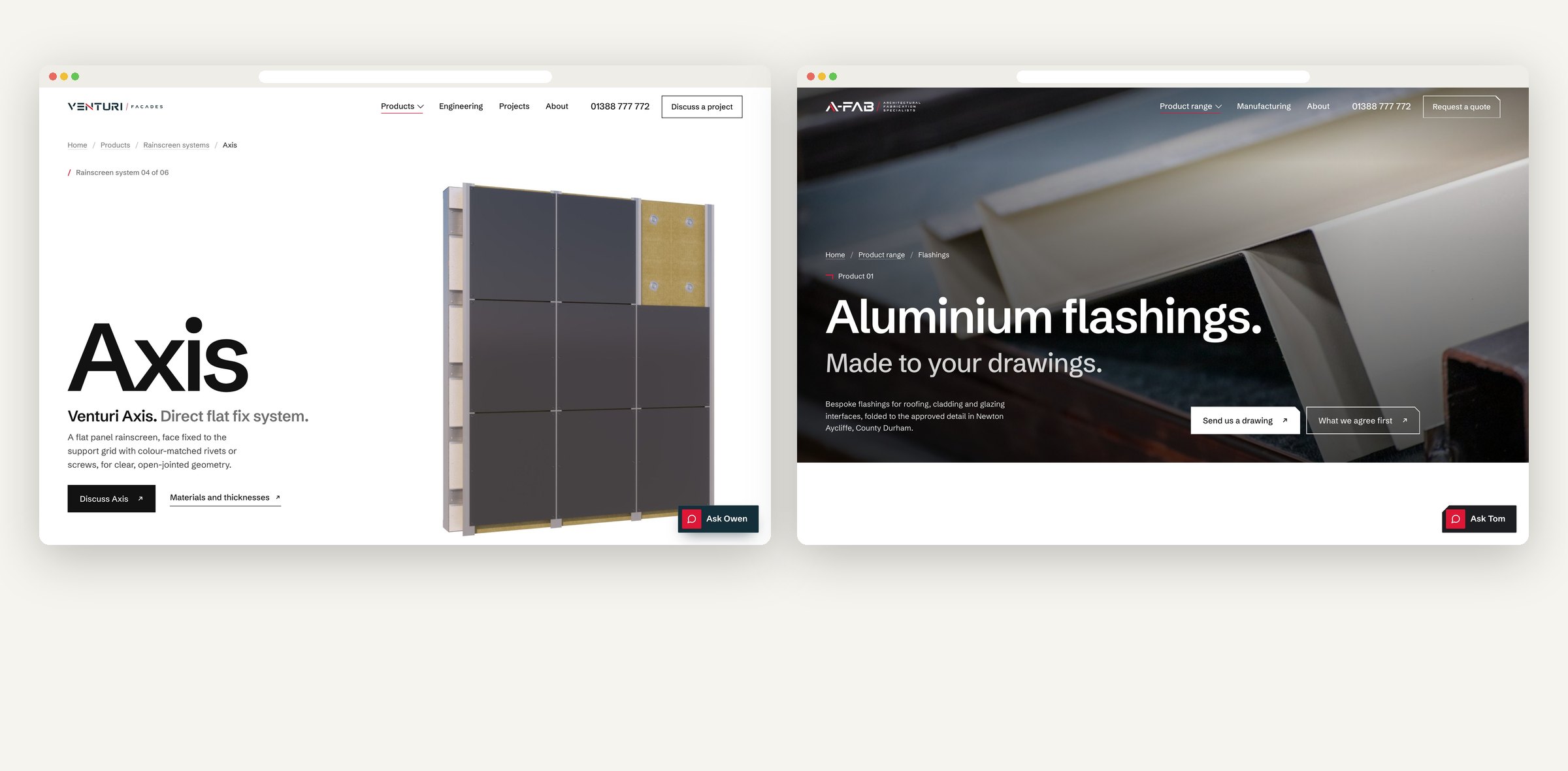
A‑FAB product pages follow the same order as Venturi’s, opening on a line drawing of the part instead of a render.
Each one says what the part does, how it is made to the drawing, what the firm agrees with you first, and ends with a form to send drawings. A visitor who learns one page knows them all.
Just as clear on site
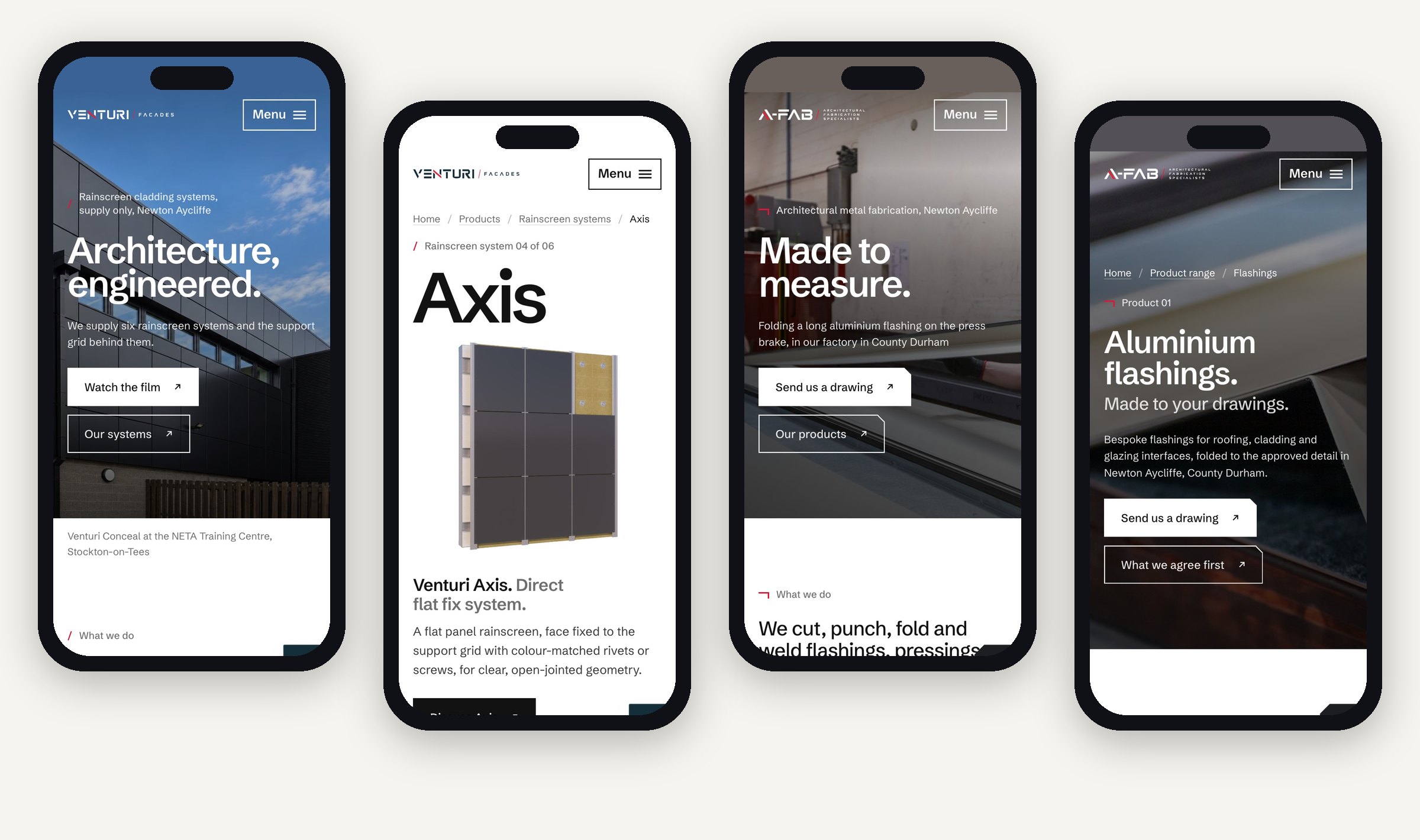
Contractors read these pages on a phone, often on site. Every page was checked at phone width as well as on a laptop.
Nothing runs off the side of the screen or sits on top of anything else. Menus fold away, buttons are big enough for a thumb, the films play in the page and the assistant opens full screen.
A film on every product page
28 films, 17 for Venturi and 11 for A‑FAB, each 30 to 41 seconds long and each on the page it explains. Press play.
How each film is made
- 1ScriptWritten from the product’s own facts. 60 to 80 words, three to six scenes.
- 2Claim checkA check stops any claim the firm can’t back up, such as fire ratings or test results.
- 3VoiceAn AI voiceover, the same voice on every film, so the set sounds like one series.
- 4MotionBuilt as motion graphics from the photos, renders and line drawings, in Venturi navy or A‑FAB graphite.
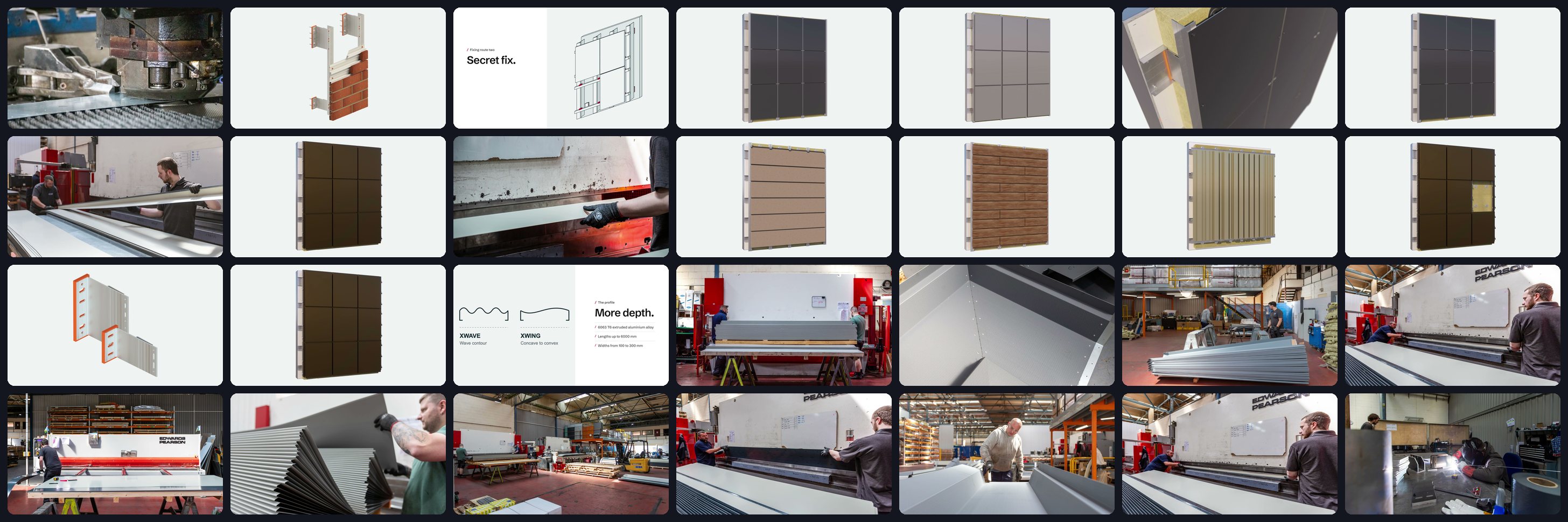
- 5Four cutsEach film cut tall for phones, 4:5, square and wide. 112 clips, with the post wording written for each.
Cut for LinkedIn and phones
Every film also comes as a tall clip for phones and three shapes for LinkedIn, with the post written for each one. Five of the tall cuts are here.
Owen and Tom, who answer out loud
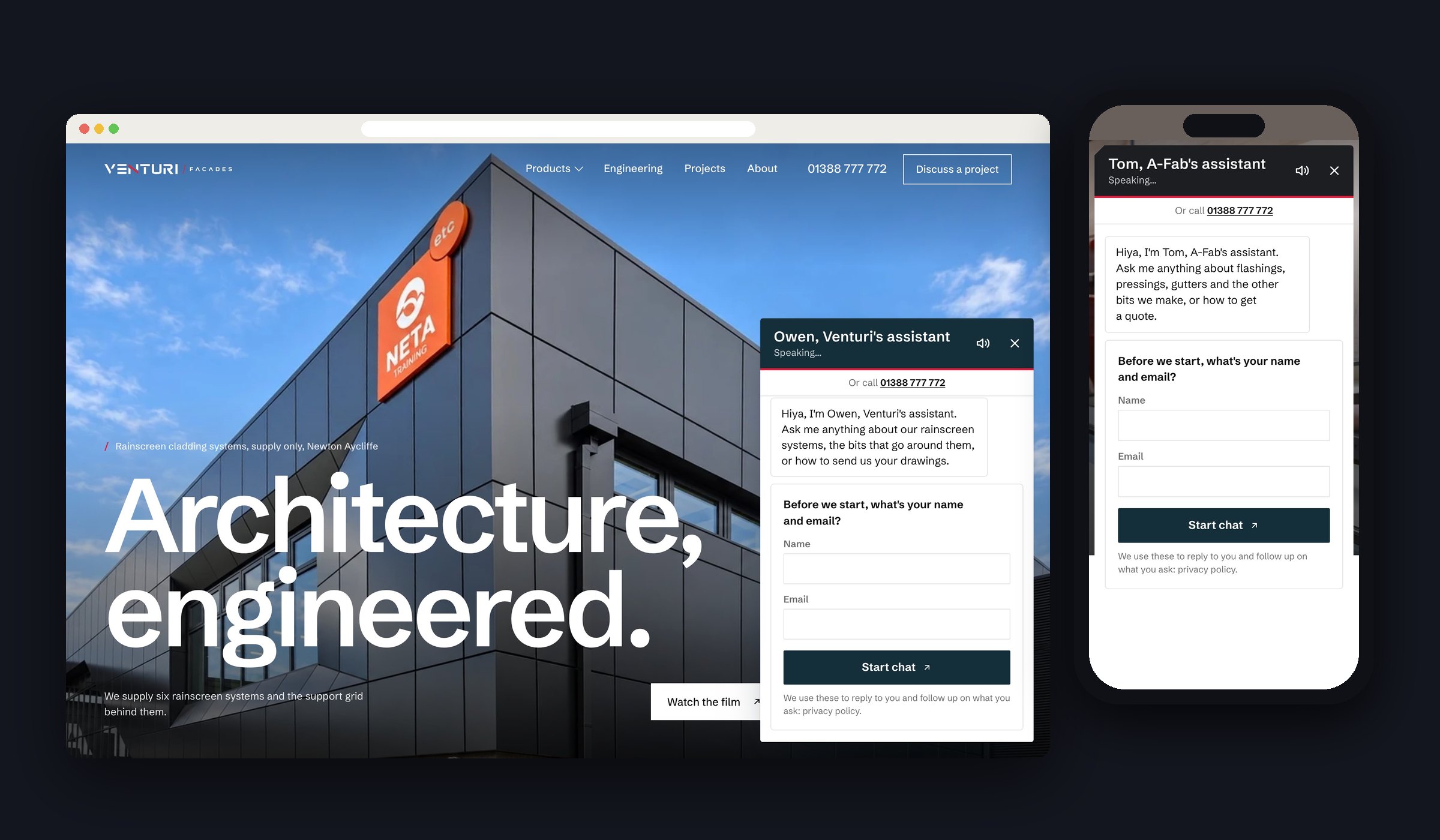
Owen answers for Venturi and Tom for A‑FAB. Visitors can type, or tap the microphone and talk, and the answer is read back in a calm North East voice.
What happens in a conversation
- 1Name and email firstThe chat asks who you are before it starts, so every conversation is a lead. Graham asked for this on the call.
- 2Type or talkOne tap on the microphone. The words appear as you speak, and the voice stops as soon as you talk over it.
- 3Answers from the site’s factsOwen and Tom only use the facts written for their own site: systems, products, materials and how to send drawings.
- 4No guessingWhen they aren’t sure, they say the team will confirm, and offer to pass the details on.
- 5To the inboxA call-back request, and a summary of the chat with the pages the visitor looked at, go to the team.
The same rules as the site
They follow the list of claims the sites can’t make. No fire ratings, certificates or test results, and no promise the firm can’t keep.
Tested with awkward questions
Asked about things outside the facts, both stay polite, say what they don’t know and point to the team.
A voice the team chose
Theo listened to a shortlist and picked a friendly, middle-aged Geordie voice. Each greeting starts with “Hiya”.
Built on Claude
The answers come from Anthropic’s Claude, the voice from ElevenLabs. Both run behind the site, so visitors install nothing.
Every enquiry to one inbox
Both sites and both assistants send to the same inbox, info@venturifacades.com, so nothing is missed between the two firms.
- 1A form on every pageName, company, email, phone and the project are needed. Drawings are optional: PDF, DWG, DXF or a photo.
- 2Its own subject lineEach enquiry arrives with the visitor’s name and the time in the subject, so two never thread together.
- 3The pages they readThe email lists the page it was sent from and the pages the visitor looked at before.
- 4Half-filled forms tooIf someone starts a form and leaves without sending, the team still gets what they typed.
Keeping what already ranks
Before rebuilding, we listed every page of the old Venturi site that Google already showed, and the searches it showed them for.
Pages that people find kept their addresses, titles and main headings. The rest were moved with a permanent redirect to the page that replaces them, 113 redirects in all, so people following an old link or bookmark land on the page that replaced it. Venturi is aimed at façade and rainscreen searches. A‑FAB is aimed at flashings, fabrications and architectural pressings, as agreed with Graham.
A search plan for both firms
- Venturi
Façade and rainscreen searches
12 new pages, spandrel panels first.
- A drawings hub and four detail pages
- Five project pages
- A board comparison and a cost guide
- A‑FAB
Flashings, fabrications, pressings
A new site starting from zero, built for the searches agreed on the call.
- One page per product
- Its own Google listing and Search Console
- Articles pointing at each product
- Both
Articles, maps and AI answers
60 articles drafted, each pointing to a main product page, going up one at a time.
- New articles every month for each firm
- Google Business Profiles
- Monthly checks of what Google’s AI and ChatGPT say
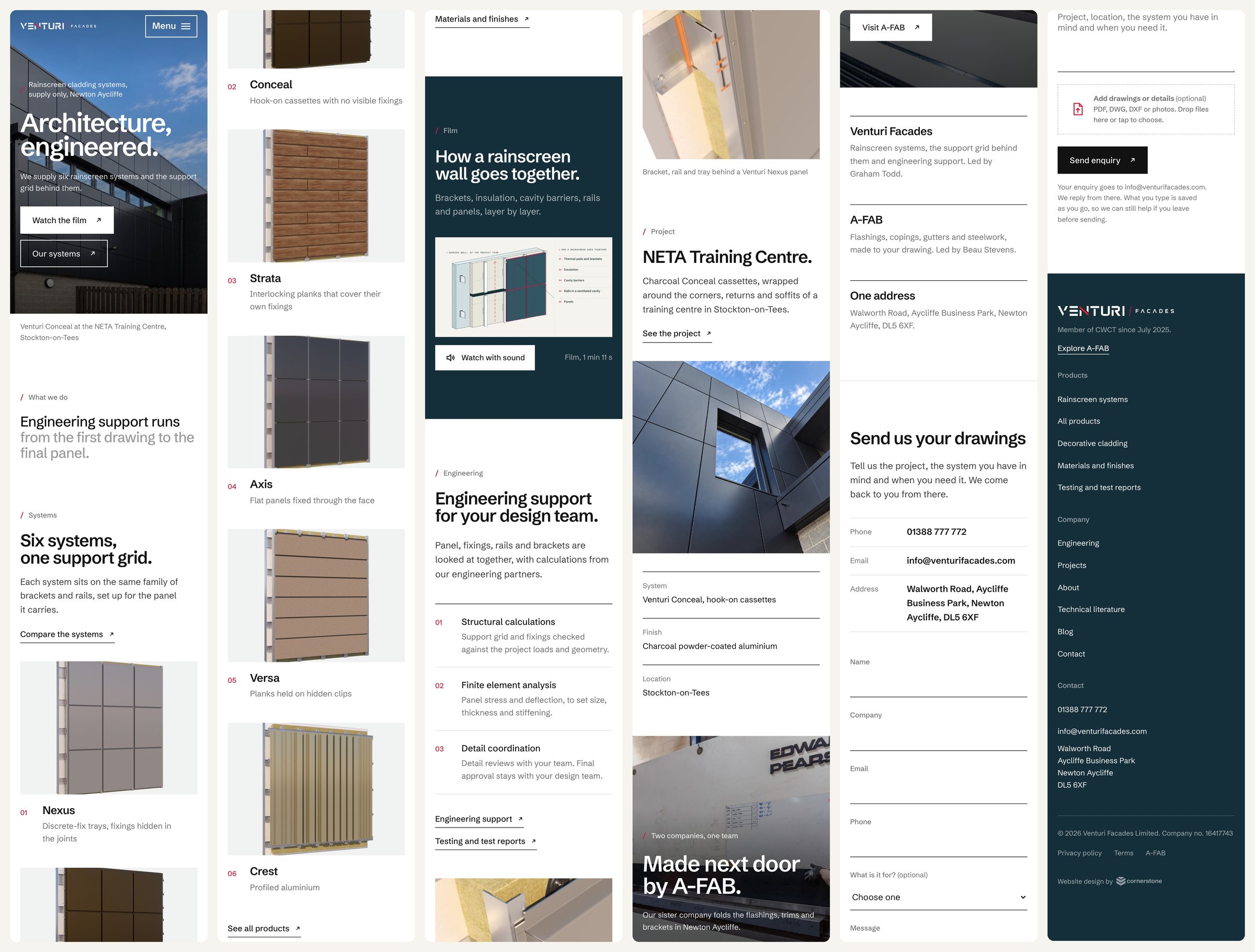
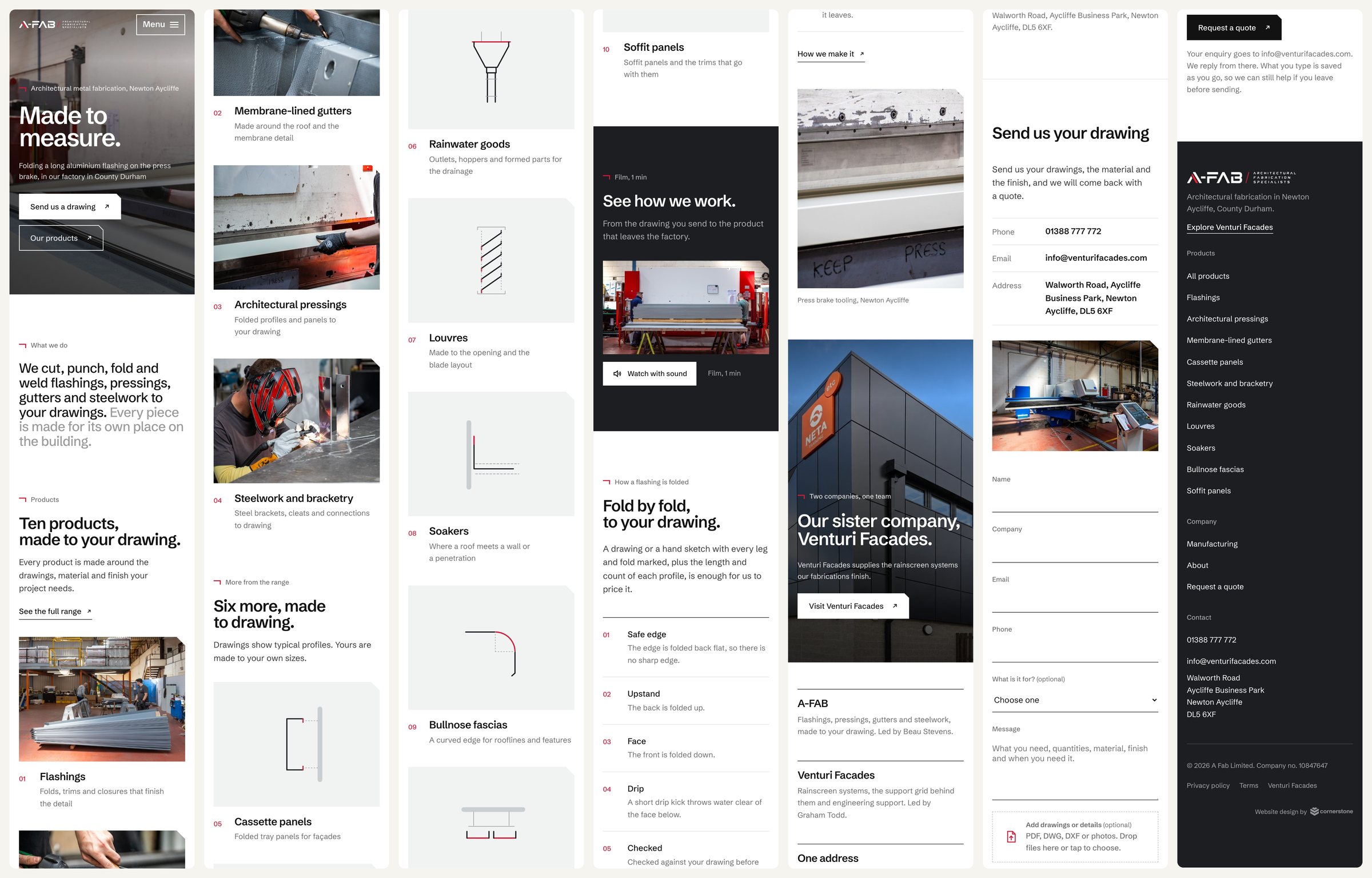
Both home pages on a phone
Each home page from top to bottom, the way it scrolls on a phone, cut into columns.
Approved, and going live
Graham approved the design on 23 November 2026. The two sites move to venturifacades.com and a‑fab.co.uk once the domains are switched over, and the articles start going up after launch, one at a time.
Until then, the links on this page open the finished sites at their review addresses. The assistants are live there, so you can talk to Owen and Tom now.
Want the same for your firm?
Tell us what you make and who buys it. We reply the same day.
Book a growth consultationOr send a message